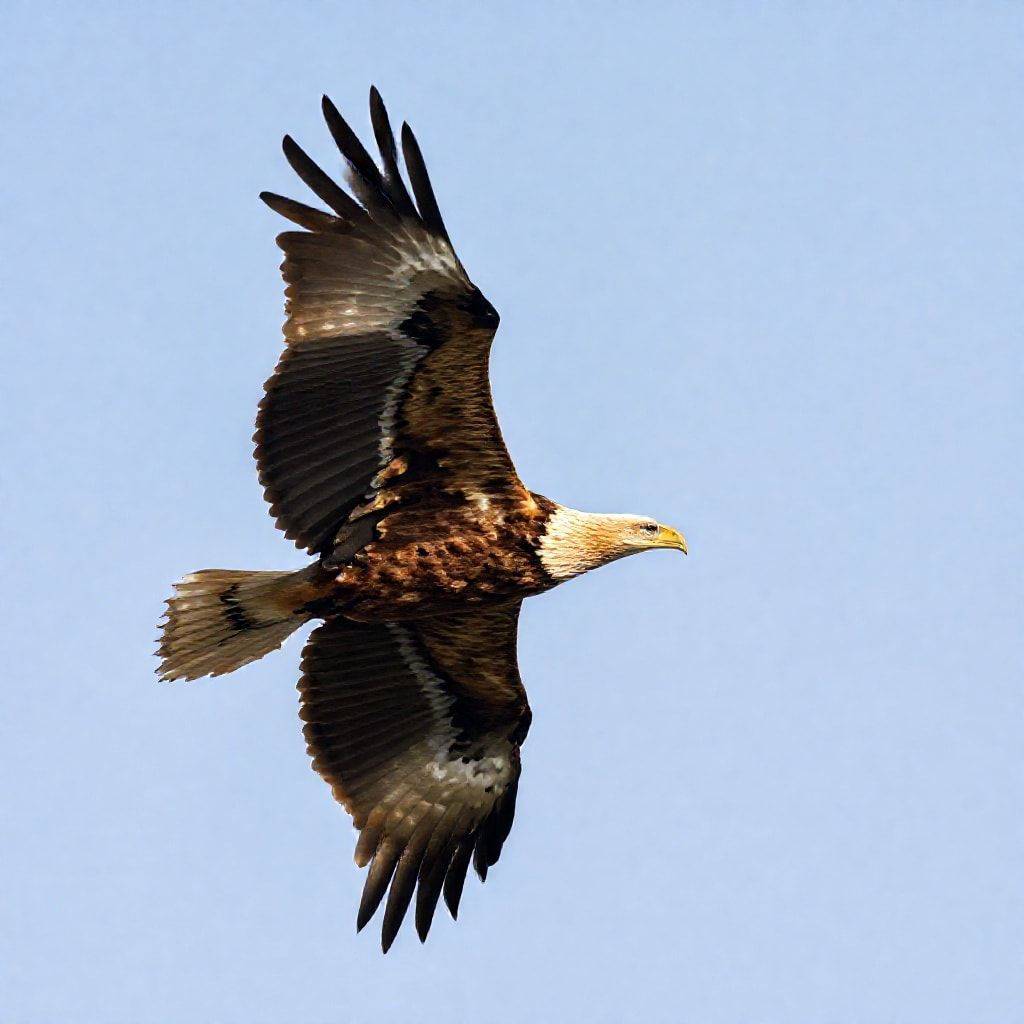
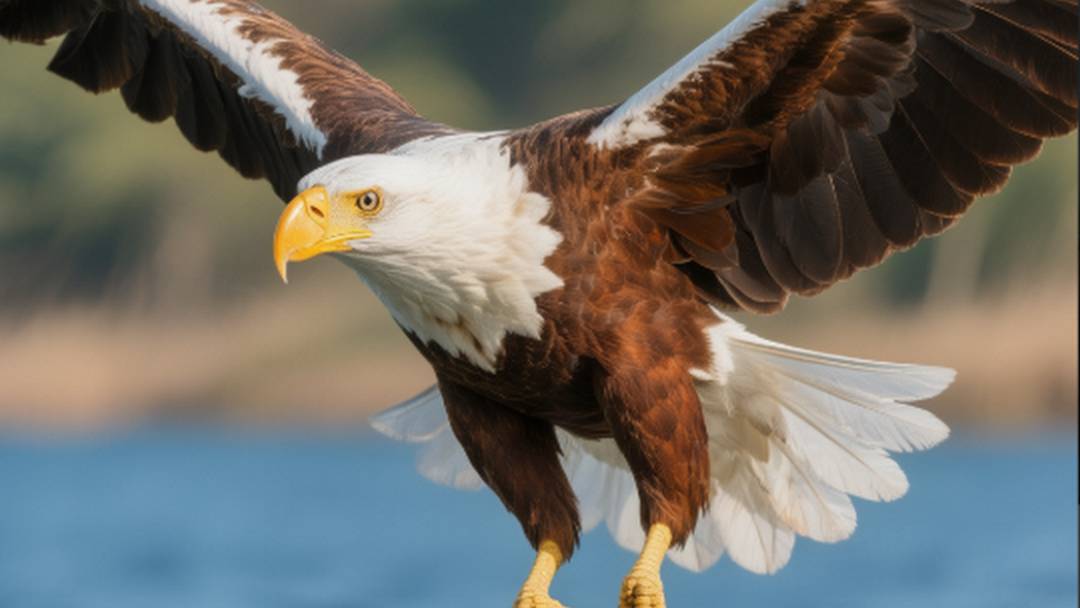
The Bald Eagle, national symbol of the United States and a superb fisherman.
Introduction
The Bald Eagle (Haliaeetus leucocephalus) is a large and powerful diurnal bird of prey from the Accipitridae family. It is the national bird and heraldic symbol of the United States of America, recognized for its majestic silhouette and contrasting plumage. Its Latin name, Haliaeetus leucocephalus, means "white-headed sea eagle", perfectly describing its aquatic habitat and its most striking visual characteristic.
This formidable hunter is primarily piscivorous, but it is also an opportunistic scavenger and kleptoparasite. After facing near extinction in the 20th century, notably due to DDT, the Bald Eagle has made a remarkable recovery thanks to intense conservation efforts, becoming a true ecological success story.
Length: 70 to 102 cm (28 to 40 in) (females are larger than males).
Wingspan: 1.80 to 2.44 meters (5.9 to 8.0 ft).
Weight: 3 to 6.3 kg (6.6 to 13.9 lbs) (females are heavier).
The Bald Eagle is classified as "Least Concern" (LC) by the IUCN globally, a testament to its spectacular recovery.
Our Ornithologist's Advice
By the Les-Oiseaux.com Team, published November 6, 2025.
My personal advice: Observing a Bald Eagle is an unforgettable experience for any ornithology enthusiast, especially in North America. It is a bird of undeniable majesty, whose flight and presence are captivating. Here are my tips to maximize your chances of spotting it:
Target aquatic areas: The Bald Eagle is a sea eagle. Look for it along ocean coasts, large lakes, wide rivers, and reservoirs. It is particularly present where fish are abundant and where large dead or living trees offer high perches and nesting sites.
Spot the white head and tail: In adults, this characteristic is unmistakable. A dark brown body contrasting with a brilliant white head and tail makes it easy to identify, even from a long distance. Juveniles, which are entirely brown, can be more challenging to distinguish initially.
Observe its distinctive flight: It soars majestically on broad, flat wings, often in ascending circles. It only flaps its wings when necessary, with deep, powerful strokes. Its flight silhouette, with its prominently visible head and long tail, is unique.
Look for large nests: Bald Eagles build some of the largest nests of any North American bird, often in the crotch of a tall, mature tree. These massive eyries (up to 2.5 meters / 8.2 ft in diameter and 4 meters / 13 ft deep, weighing over 1 short ton) are reused year after year and are an excellent indicator of their presence.
Pay attention to its hunting behavior: Watch it fish, plunging towards the water with talons outstretched to catch a fish. It may also fly over the surface to spot injured fish or even steal prey from other birds, like Ospreys.
The restoration of the Bald Eagle is a strong symbol of conservation success. Each observation is a reminder of the importance of protecting our ecosystems and their emblematic inhabitants.
Have you observed the Bald Eagle?
Share your experience and photos! Your observations enrich the Les-Oiseaux.com community.
You can share as a guest or create an account to track your contributions.
Identification of the Bald Eagle
The Bald Eagle is a very large raptor, easily identifiable in adulthood by its characteristic plumage. It is one of the most famous "white-headed eagles."
Adult Plumage: The body is dark brown, almost black, contrasting sharply with a pure, brilliant white head and tail. The long flight feathers are also dark brown.
Head: Entirely white in adults, with a large and powerful beak. The name "bald" derives from an older meaning of the word, "white-headed."
Eyes: Bright yellow, giving it a keen and piercing expression.
Beak: Large, bright yellow, and strongly hooked, perfectly adapted for catching fish.
Legs: Yellow, robust, with large black talons. The legs are feather-free, which is typical of fish-eating raptors.
Juvenile: Young Bald Eagles are mostly brown, with irregular white mottling on the body and underwings, and a darker bill. The head and tail gradually whiten over the first four to five years of their life to achieve the adult coloration.
Silhouette and Flight: In flight, its large size is impressive. It soars on long, broad wings, often held flat or in a very slight dihedral. Wingbeats are slow and powerful. The silhouette is distinctive, with the head and long wedge-shaped tail extending well beyond the rest of the body.
Scientific Dimensions and Records (Bald Eagle)
Characteristic
Male
Female
Average / Record
Length
70 – 90 cm (28 – 35 in)
80 – 102 cm (31 – 40 in)
70 – 102 cm (28 – 40 in)
Wingspan
1.80 – 2.13 m (5.9 – 7.0 ft)
2.0 – 2.44 m (6.6 – 8.0 ft)
1.80 – 2.44 m (5.9 – 8.0 ft)
Weight
3 – 4.5 kg (6.6 – 9.9 lbs)
4.5 – 6.3 kg (9.9 – 13.9 lbs)
3 – 7.4 kg (6.6 – 16 lbs) (up to 8.2 kg / 18 lbs record)
Lifespan
20 – 30 years (in the wild)
20 – 30 years (in the wild)
Up to 38 years (record in the wild), 50 years (in captivity)
These dimensions highlight the impressive size and longevity of this majestic North American raptor.
The Golden Eagle is another large North American raptor. Adults are almost entirely dark brown, with a golden nape, and lack the white head and tail of the Bald Eagle. Juvenile Golden Eagles have distinct white patches at the base of the primaries and often a white tail base, but this band is clearer and limited to the tail, not extending to the head. In flight, the Golden Eagle holds its wings in a more pronounced dihedral ("V" shape) than the Bald Eagle, which flies with flat wings. Additionally, Golden Eagles have feathered legs all the way to their feet, unlike the bare-legged Bald Eagle.
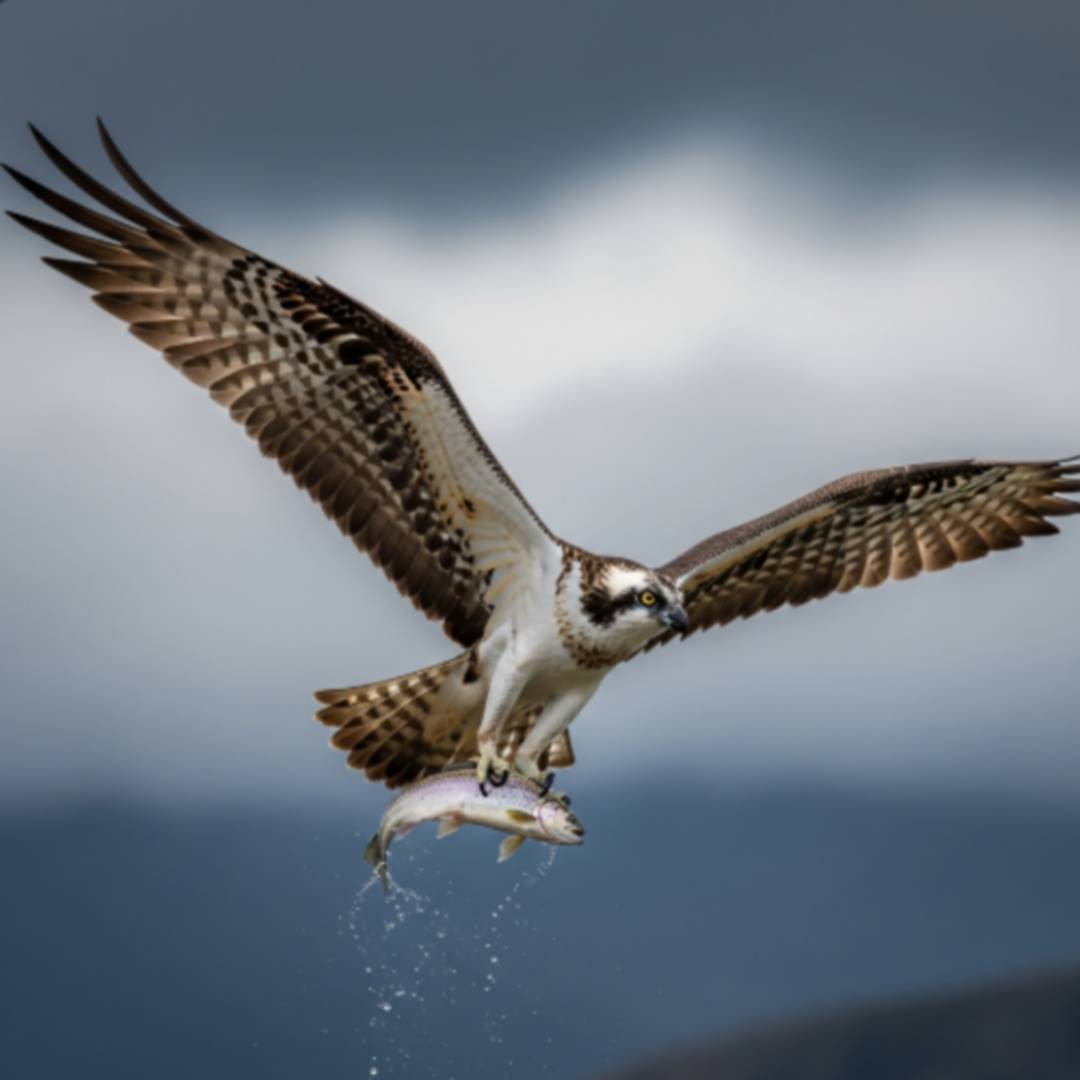
The Osprey shares the aquatic habitat of the Bald Eagle and is also an expert fisherman. However, the Osprey is significantly smaller, has a more slender body, and is distinguished by its white head crossed by a distinctive black eye stripe. Its underparts are white with a dark pectoral band and dark carpal patches under the wings, and its tail is barred. Its flight silhouette is also different, with wings held in a distinct "M" shape. The Bald Eagle is much larger and more robust.
The African Fish Eagle is another raptor of the same genus (Haliaeetus) but is native to Africa. While it also has a white head, its body is a distinctive chestnut brown, and its wings are black. It does not have the entirely white tail like the Bald Eagle, and its eyes are dark, unlike the Bald Eagle's yellow eyes. Its geographical distribution is a major distinguishing factor.
The Bald Eagle is a rather vocal raptor, especially during the breeding season or in the presence of conspecifics. Contrary to its majestic image, its call is not as powerful or "noble" as that of the African Fish Eagle, often being described as weak chirps or high-pitched whistles.
Its calls can include:
Contact and Alarm Calls: It emits a series of high-pitched, piercing whistles, often transcribed as "kleek-kik-ik-ik-ik" or "hee-hee-hee". These calls are used for territorial communication, signaling intruders, or excitement.
Begging Calls of Young: Chicks and young in the nest make more insistent and louder cries to demand food, often sounding like a gull.
Duetting: Pairs may sometimes engage in duets, synchronizing their calls, though less frequently and melodically than in other sea eagle species.
Interestingly, the powerful scream often associated with Bald Eagles in movies and on TV is typically dubbed in, actually belonging to the Red-tailed Hawk, as the Bald Eagle's natural calls are considered less intimidating.
0:00 / 0:00
Habitat and Distribution of the Bald Eagle
The Bald Eagle is a species endemic to North America, where it is widely distributed, although its density varies considerably by region.
It is primarily found in habitats near:
Large bodies of water: Whether coastal areas, estuaries, deltas, large inland lakes, rivers, or reservoirs. The presence of open water for fishing is paramount.
Old-growth forests: It prefers mature forest areas (coniferous or hardwood) near water, as it needs large, sturdy trees for nesting and perching. These trees must offer good visibility and be protected from disturbance.
Alaska and Canada: These regions host the highest concentrations of Bald Eagles during the breeding season. It is also found in most of the contiguous United States and northern Mexico.
Northern populations are migratory, moving south in winter to find open waters and food sources. Southern populations are resident year-round.
Distribution Map
Year-round Presence (Resident)
Breeding Area
Non-breeding (Wintering) Area
Passage Area (Migration)
Diet of the Bald Eagle
The Bald Eagle is an agile predator and an opportunistic scavenger, but its diet is predominantly piscivorous. It is an expert in catching fish.
It primarily feeds on:
Fish: Its preferred food. It fishes by flying low over the water or swooping from a perch, snatching fish near the surface with its powerful talons. It prefers fish that are already dead or dying, or those swimming near the surface, but it is capable of catching healthy fish. At least 100 species of fish have been recorded in its diet.
Aquatic Birds: It can also hunt other aquatic birds, such as gulls, ducks, coots, or geese, attacking them in flight or on the water.
Small Mammals: Occasionally, it captures small mammals like rabbits, squirrels, marmots, or muskrats.
Carrion: It is an important scavenger, feeding on animal carcasses (fish, mammals) found on shores or ice.
Kleptoparasitism: It is known to steal prey from other raptors or seabirds, notably Ospreys, by harassing them in flight until they drop their catch.
The Bald Eagle has keen eyesight, allowing it to spot prey from high above. Its talons, though less powerful than those of the Golden Eagle, are perfectly adapted for gripping slippery fish.
Reproduction of the Bald Eagle
The Bald Eagle is monogamous and forms stable pairs that often mate for life, returning to the same nesting site year after year. Sexual maturity is attained between 4 and 5 years of age, at which point they acquire their distinctive adult plumage.
Nesting: The Bald Eagle builds massive nests, among the largest of any North American bird. These eyries are typically located in large trees (pines, oaks, firs) at a significant height, or sometimes on cliffs. The nest is made of intertwined branches, twigs, grasses, and feathers, and can measure up to 2.5 meters (8.2 ft) in diameter and 4 meters (13 ft) deep, weighing over 1 short ton. Pairs may have several alternative nests within their territory.
Courtship Display: Aerial displays are spectacular, including synchronized flights, chases, and a unique behavior where both birds lock talons in flight, spiraling and tumbling before separating just before hitting the ground.
Eggs: The female typically lays 1 to 3 eggs (most often 2), which are off-white or cream in color. Laying occurs between February and May, depending on latitude. Incubation lasts about 34 to 36 days and is shared by both parents, though the female spends more time on the nest.
Raising the Young: Chicks hatch covered in grayish down. They are fed by both parents. Feeding is intensive, with adults primarily bringing fish to the nest. Fledging occurs approximately 10 to 12 weeks after hatching. After fledging, juveniles remain dependent on adults for several more weeks (up to 6-10 weeks) to learn hunting skills and survive, before dispersing.
Conservation Status of the Bald Eagle
The Bald Eagle is classified as "Least Concern" (LC) by the IUCN (International Union for Conservation of Nature) globally (last assessed in 2016/2021). It is an emblematic example of conservation success, following a dramatic decline in the 20th century.
Historically, the species suffered a massive decline, primarily due to:
Organochlorine Pesticides (DDT): The widespread use of DDT after World War II led to eggshell thinning, making reproduction impossible.
Hunting and Persecution: It was once hunted for sport, for meat, or because it was perceived as a predator of poultry or fish.
Habitat Loss and Degradation: Deforestation and human development along coastlines and rivers destroyed many nesting and hunting sites.
Thanks to the ban of DDT in the United States and Canada in the 1970s, legal protection of the species (Endangered Species Act in the US, Migratory Bird Treaty Act), and reintroduction programs, the Bald Eagle population has seen a spectacular recovery. It was removed from the US list of endangered and threatened species in 2007.
Today, remaining threats include localized habitat destruction, collisions with vehicles or power lines, and lead poisoning from ingesting hunting ammunition or fishing weights. However, its population is globally stable and continues to grow.
Frequently Asked Questions (FAQ) about the Bald Eagle
How to identify the Bald Eagle?
The Bald Eagle (Haliaeetus leucocephalus) is a large North American raptor easily identifiable. Adults have a pure, brilliant white head and tail, contrasting with a dark brown body. Its beak is large, yellow, and hooked, and its eyes are also yellow. Juveniles are mostly brown and acquire their distinctive plumage over several years.
Where does the Bald Eagle live?
The Bald Eagle is native to North America, where it is widely distributed across Canada, the United States (including Alaska), and northern Mexico. It prefers habitats near large bodies of fresh or saltwater, such as coastlines, lakes, rivers, and reservoirs, especially if surrounded by old-growth forests with mature trees for nesting and perching.
What does the Bald Eagle eat?
The Bald Eagle is an opportunistic predator and scavenger, with a diet primarily composed of fish. It fishes by swooping down to the water to snatch its prey with powerful talons. It also consumes other aquatic birds, small mammals, and carrion (e.g., animal carcasses found on shores). It may also steal food from other raptors, such as the Osprey.