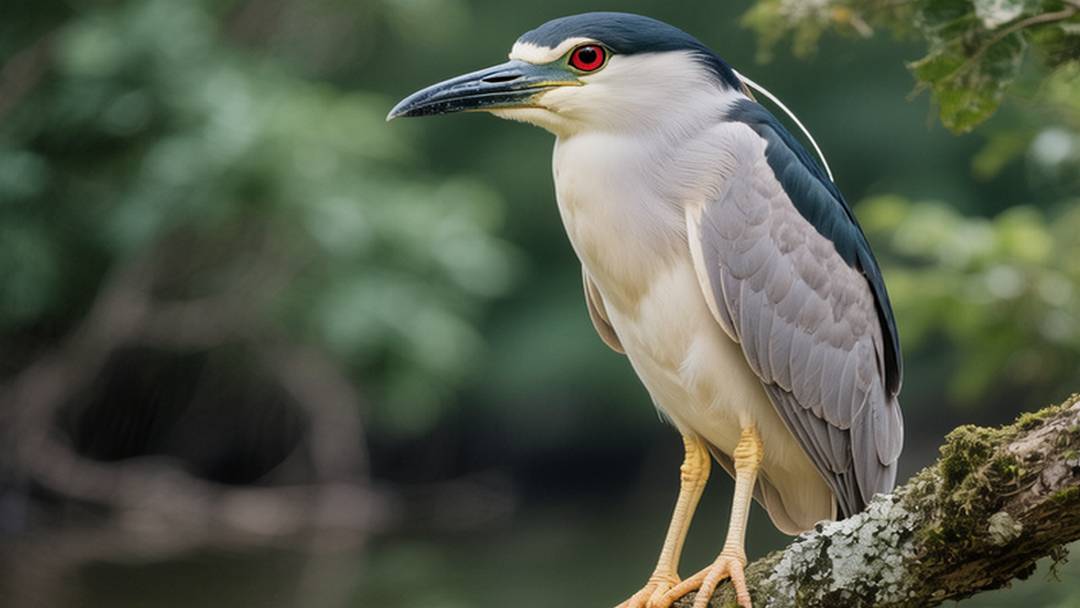
The Black-crowned Night Heron, a stocky and mysterious wader.
Introduction
The Black-crowned Night Heron (Nycticorax nycticorax) is a medium-sized heron, stocky and robust. Although it belongs to the same family as the elegant Little Egret or the large Grey Heron, it is distinguished by its hunched silhouette and its primarily crepuscular and nocturnal habits. Its average dimensions are:
Length: 58 to 65 cm
Wingspan: 105 to 112 cm
Weight: 500 to 800 grams
Its Latin name Nycticorax means "night raven," referring to its raucous call similar to that of a corvid and its nocturnal activity. It often spends its days hidden in the dense foliage of riverside trees, which sometimes makes it difficult to observe despite its wide distribution.
Our Ornithologist's Advice
By the Les-Oiseaux.com team.
My personal advice: The best time to observe the Black-crowned Night Heron is at twilight ("the blue hour"), when it leaves its roost to go fishing.
The hunched silhouette: Unlike the Grey Heron which often stands with its neck extended, the Night Heron seems to "have no neck" when at rest. It tucks its head into its shoulders, giving it a very characteristic hunchbacked appearance.
The diurnal roost: During the day, look in willows and alders by the water's edge. If you see motionless and compact shapes perched in the shade, it is often a colony of Night Herons resting.
It frequently coexists on nesting islands with the Eurasian Spoonbill or the Black-winged Stilt, so take the opportunity to scan the trees around mixed colonies.
Have you seen this "night raven"?
Share your observations on our community map.
You can share as a guest or create an account to track your contributions.
Identification
The appearance of the Black-crowned Night Heron changes radically between the juvenile stage and adulthood.
Adult: The plumage is contrasted and elegant. The cap and back are slate black with metallic green sheen. The wings and tail are ash grey. The underparts are greyish white. In the breeding season, two or three long, very fine white feathers (plumes) adorn the nape. The eye is bright red.
Juvenile: It is totally different, dark brown streaked and spotted with yellowish white or buff. It closely resembles a Eurasian Bittern or a young of other herons, but its teardrop-shaped spots on the wings are distinctive. Its eye is yellow or orange.
Bill: Black, robust and pointed, slightly shorter than that of other herons.
Legs: Yellow to yellow-green, they can turn bright pink during courtship display.
The young Night Heron can be confused with the Bittern, but its posture remains more hunched.
The Grey Heron is significantly larger (about 90-98 cm). Its neck is very long and often visible, its bill is yellow and powerful. In flight, its wingbeats are slower and more majestic than those of the Night Heron.
Although comparable in size, the Little Egret is entirely white with a very fine black bill and characteristic yellow feet. Its silhouette is much more slender and graceful than the stocky one of the Night Heron.
The Black-crowned Night Heron is generally silent away from colonies, but it makes itself heard in flight, especially at dusk and at night. Its vocal repertoire is quite surprising for a heron.
Flight Call: A raucous, deep, and sudden "kow-ak" or "gwok", which surprisingly recalls the croak of a raven. It is often this sound that betrays its passage in the dark.
At the colony: Exchanges are noisy, consisting of grunts, bill-clattering, and guttural sounds during displays or territorial disputes.
0:00 / 0:00
Habitat and Distribution
The Black-crowned Night Heron is a cosmopolitan species, present on all continents except Antarctica and Australia. In Europe, it is a summer migrant.
Habitat: It favors wetlands bordered by trees and dense bushes (willows, poplars, alders) which serve as diurnal roosts and nesting sites. It is found in freshwater marshes, ponds, calm riverbanks, and sometimes mangroves or rice fields. It often shares its territory with the Common Moorhen which frequents the lower layer of vegetation.
Wintering: From late summer, European populations migrate to sub-Saharan Africa. A few individuals may attempt to spend the winter in southern France or Spain.
Distribution Map
Present all year (Resident)
Breeding range
Wintering range (Non-breeding)
Diet
The Black-crowned Night Heron is an opportunistic hunter that fishes mainly at twilight and at night, thus avoiding direct competition with other diurnal herons like the Great Crested Grebe or the Grey Heron.
Small and medium-sized fish.
Amphibians (frogs, newts).
Aquatic insects and their larvae.
Sometimes small rodents or even nestlings of other species.
It hunts by ambush, motionless on a low branch above the water or standing in the mud, waiting for prey to pass within range of its dagger-like bill.
Reproduction
The Black-crowned Night Heron is a colonial (gregarious) bird. It nests in "heronries," often mixed, in the company of other species like the Little Egret or the Cattle Egret.
The Nest: A rough platform of twigs, built by the pair in a tree or bush, often close to water.
Clutch: The female lays 3 to 5 pale blue-green eggs between April and June.
The Young: The chicks hatch covered in down and are fed by regurgitation. They become very noisy as they grow. Although they only fly after 6 to 7 weeks, they venture out of the nest to climb on neighboring branches ("clambering") well before their first flight.
Conservation Status
Classified as "Least Concern" (LC) globally, the Black-crowned Night Heron saw its populations decline locally in Europe during the 20th century due to wetland destruction and persecution. Now protected, its numbers are stable or slightly increasing in some regions.
The preservation of old trees bordering ponds and the tranquility of nesting areas are essential for its survival, just as for the White Stork which sometimes shares the same habitats.
Frequently Asked Questions (FAQ)
Is the Night Heron dangerous?
No, absolutely not to humans. It is a shy bird that flees at the slightest alarm. Like all herons, however, it can use its bill to defend itself if captured or injured.
Can it be seen in cities?
Yes, it adapts well to urban parks with bodies of water featuring quiet wooded islands (such as the Jardin des Plantes in Paris or the Parc de la Tête d'Or in Lyon), where it can be observed more easily than in the wild.