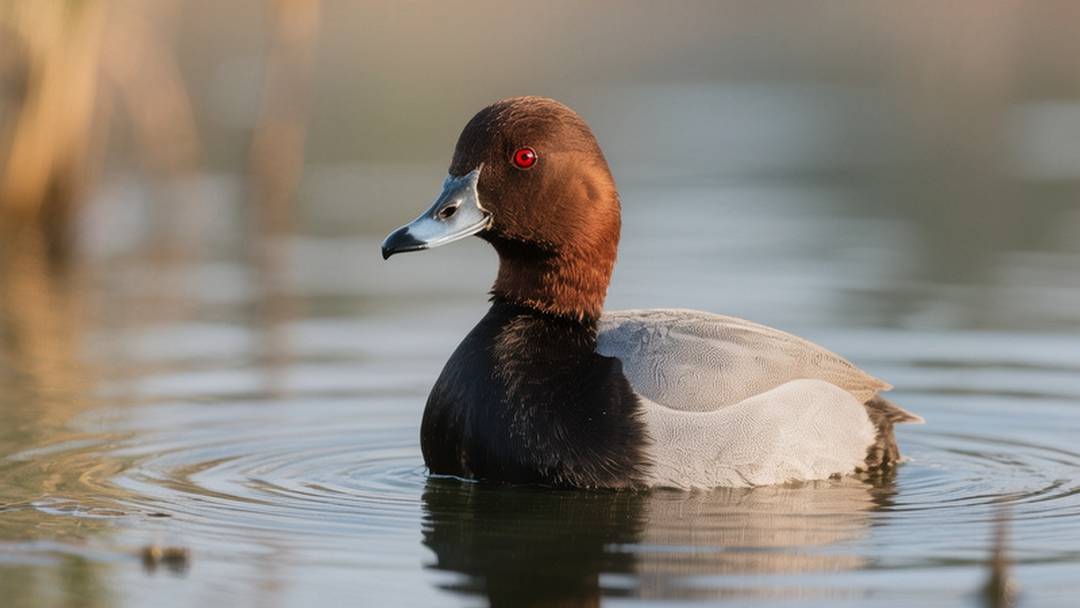
The male Common Pochard is easily recognized by its "tricolor" pattern: red head, black chest, and grey body.
Introduction
The Common Pochard (Aythya ferina) is a diving duck common in winter on European lakes and reservoirs, though its breeding numbers are declining. It is a gregarious bird, often forming large rafts mixed with other diving ducks. Its average dimensions are:
Length: 42 to 49 cm
Wingspan: 72 to 82 cm
Weight: 700 to 1,100 grams
Known for its distinctive profile with a sloping forehead that merges smoothly into the bill (a "Roman nose"), it is an expert diver but seems heavy and clumsy on land.
Our Ornithologist's Advice
By the Les-Oiseaux.com team.
My personal advice: To identify the Common Pochard quickly, look for the profile and the color blocks.
The Silhouette: Look at the head shape. Unlike the round head of the Tufted Duck or the high forehead of the Goldeneye, the Pochard has a triangular profile where the forehead slopes directly into the bill without a marked angle.
The "Sandwich" Pattern: In the male, the very pale grey body is sandwiched between a black chest and a black tail area. This is very visible from a distance.
In winter, they sleep a lot during the day, floating in compact groups in the middle of water bodies. They become more active and feed closer to twilight.
Have you spotted a Common Pochard?
Share your experience and photos! Your sightings enrich the Les-Oiseaux.com community.
You can share as a guest or create an account to track your contributions.
Identification
The plumage differs significantly between sexes.
Adult Male (Breeding): Unmistakable. The head and neck are a rich rusty-red. The breast is black, contrasting sharply with the very pale, finely vermiculated grey body (appearing whitish from afar). The rear (undertail) is black. The eye is a striking red. The bill is dark grey with a pale blue-grey band across the middle.
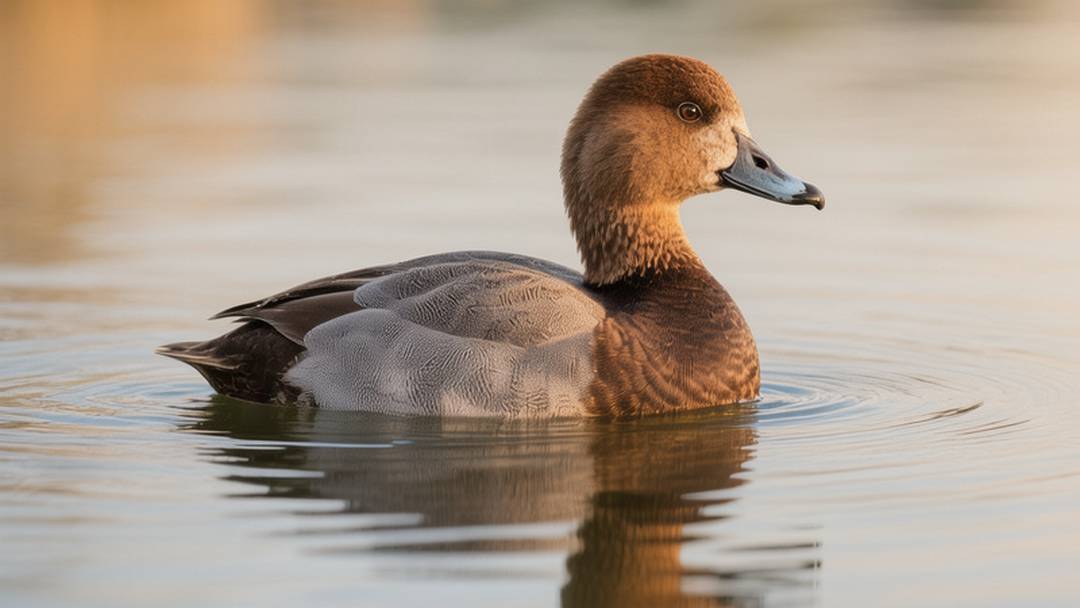
Female: Much more discreet. The head is dull brown, sometimes with a diffuse pale patch on the cheek and behind the eye. The body is greyish-brown. The eye is dark brown. The bill pattern is similar to the male's but duller.
Eclipse Male: In summer, the male resembles the female but retains a greyer (less brown) body and the distinct red eye.
In Flight: Unlike the Goldeneye or Tufted Duck, the Common Pochard does not have a white wing bar. Instead, it shows a broad, diffuse grey stripe on the flight feathers.
The female is brownish-grey but shares the distinctive sloping head profile.
Dimensions (Common Pochard)
Characteristic
Data
Length
42 – 49 cm
Weight
700 – 1,100 g
Wingspan
72 – 82 cm
Lifespan
Up to 10 years
Not to be confused with...
Red-crested Pochard
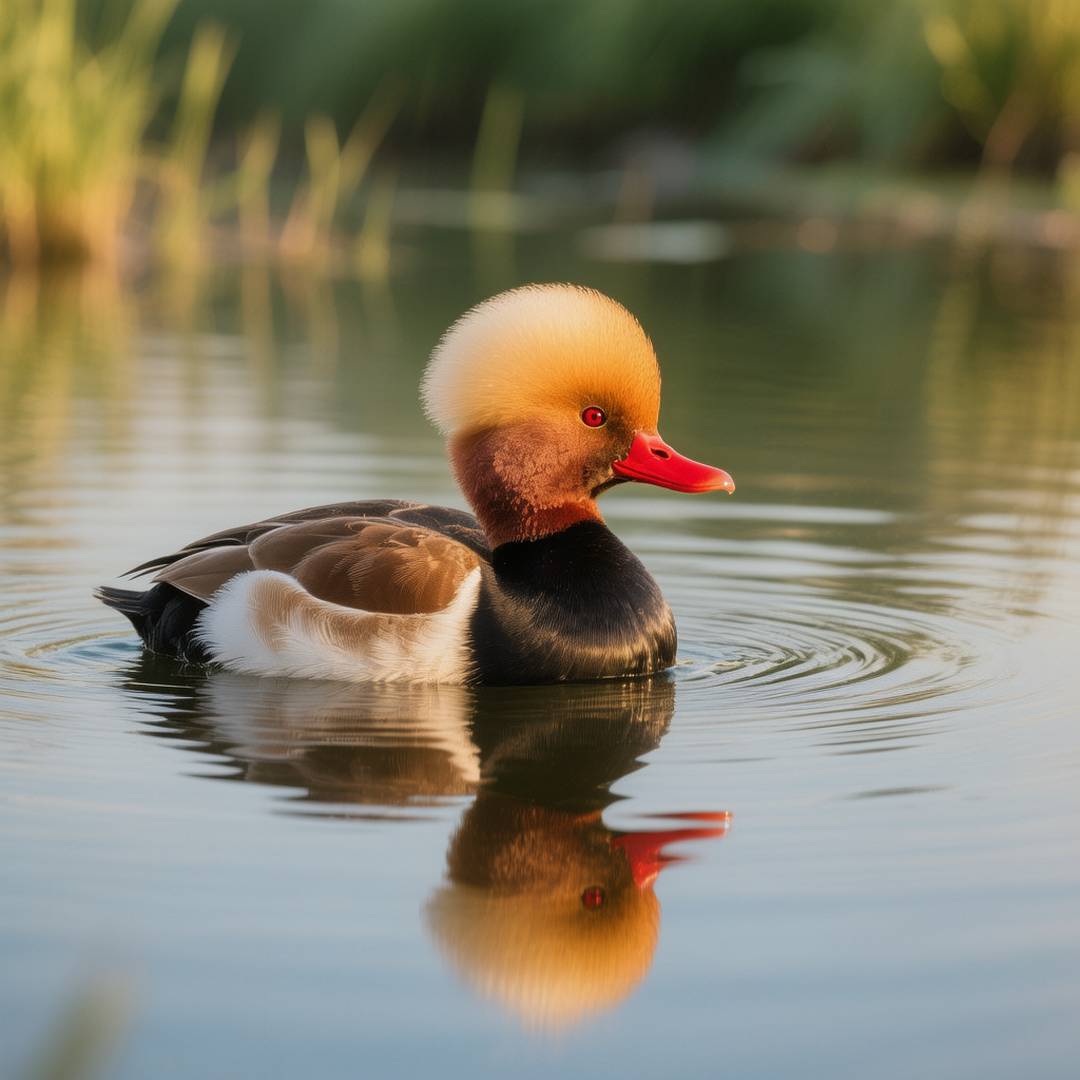
The male Red-crested Pochard has a broader, more orange (fox-colored) head, a bright red bill, and white flanks (not grey). It looks bulkier.
Eurasian Wigeon
Sometimes confused due to the reddish head. However, the Wigeon has a yellow forehead, a pinkish breast, and is a surface feeder (dabbling duck), rarely diving.
Song and Calls
The Common Pochard is a generally silent bird, especially in winter. However, during the spring courtship displays, vocalizations become more frequent.
Male: Produces a soft, wheezy whistle, sometimes described as a nasal cut-off sneeze, thrown upwards during head-throw displays.
Female: Emits loud, harsh growls ("karrr-karrr") often heard when flushed or communicating with ducklings.
0:00 / 0:00
Habitat and Distribution
The Common Pochard prefers lowland waters that are nutrient-rich (eutrophic).
Breeding: Shallow lakes, marshes, and ponds with extensive reedbeds or fringing vegetation, which are essential for nesting.
Wintering: Moves to larger, open bodies of water, including reservoirs, gravel pits, and lakes. It is less coastal than the Goldeneye but can be found in brackish estuaries. Large flocks concentrate in Central and Western Europe.
Distribution Map
Present all year (Resident)
Breeding range
Wintering range (Non-breeding)
Diet
The Pochard is an omnivorous diver. It forages mostly by diving, typically for 10 to 20 seconds.
Vegetation: A significant part of its diet includes seeds, roots, and vegetative parts of aquatic plants, particularly stoneworts (Chara), pondweeds, and milfoil.
Animal Matter: It also consumes aquatic invertebrates such as mollusks, caddisfly larvae, chironomids, and sometimes small amphibians or fish.
They often feed at night or in the twilight hours.
Reproduction
The Common Pochard is a solitary nester, though nests can sometimes be grouped loosely.
The Nest: Built on the ground, usually within thick reedbeds or on floating mats of vegetation. It is a pile of reeds and leaves, lined with thick grey down.
Clutch: The female lays 6 to 11 greenish-grey eggs between April and June. Incubation lasts about 24 to 28 days.
The Young: The precocial ducklings leave the nest shortly after hatching. They are cared for by the female but feed themselves. They fledge after 50 to 55 days.
Conservation Status
The Common Pochard is currently classified as Vulnerable (VU) on the IUCN Red List. This status reflects a significant and rapid population decline across its range.
Threats include:
Loss of wetland habitat (drainage of marshes).
Eutrophication and pollution changing the aquatic vegetation balance.
Hunting pressure in certain migration and wintering areas.
Climate change affecting breeding range suitability.
Frequently Asked Questions (FAQ)
How can I tell a female Pochard from a female Tufted Duck?
The female Tufted Duck is darker brown (almost blackish), has a yellow eye (Pochard has a dark eye), and usually shows a hint of a crest. The Pochard female has a distinct triangular head shape without any crest and lighter, greyish cheeks.
Do Common Pochards dive deep?
They typically dive in water between 1 and 2.5 meters deep, rarely exceeding 3 or 4 meters. They prefer shallower waters than Goldeneyes or Tufted Ducks for feeding on bottom vegetation.