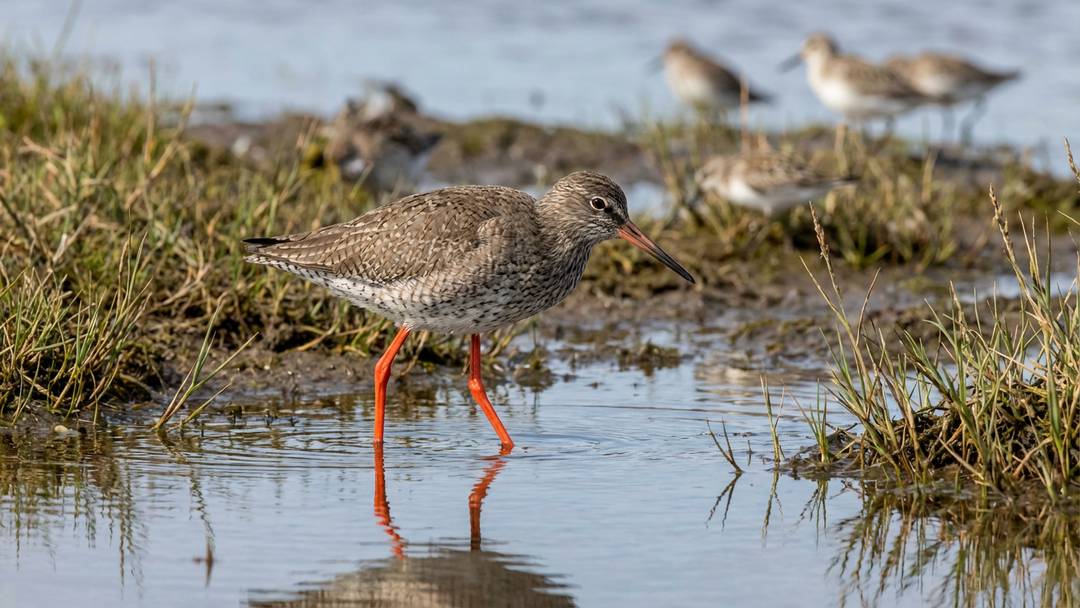
The Common Redshank, often nicknamed the 'sentinel of the marshes'.
Introduction
The Common Redshank (Tringa totanus) is a medium-sized wader (shorebird), iconic of coastal wetland and flooded grasslands. A member of the Scolopacidae family, its average dimensions are:
Length: 27 to 29 cm
Wingspan: 59 to 66 cm
Weight: 85 to 155 grams
It is best known for its long bright red legs, which give it its English name, and for its role as an alarm system in the marshes. Very noisy, it is often the first bird to signal human presence or that of a predator, triggering the flight of all other waders nearby.
Our Ornithologist's Advice
By the Les-Oiseaux.com team.
My personal advice: The Common Redshank is often easier to hear than to see at first. If you are walking near a salt marsh or an estuary, keep an ear out for its flute-like, melancholic call "tyü-hü-hü".
The flight clue: This is the infallible criterion! When the bird takes flight, look at its wings. The Common Redshank is one of the few 'shanks' (Tringa species) to possess a broad white bar at the rear of the wing (trailing edge). This white "mirror" contrasts strongly with the dark upper wing.
Nervous attitude: Observe its behavior. It often bobs its head up and down when anxious. Unlike other waders that remain silent to hide, the Redshank prefers to fly off noisily.
Look for it at the edge of mudflats, probing the soft mud, or perched on a fence post in salt meadows, a position it particularly favors to survey its territory.
Have you spotted a Redshank?
Share your observations on our community map.
Identification
The Common Redshank has an elegant yet robust silhouette for a wader.
Legs: They are the most obvious feature. They are long and vivid orange-red (sometimes duller in juveniles).
Bill: Medium length, straight, red at the base (about half the length) and black at the tip.
Plumage:
Summer (Breeding): Upperparts are greyish-brown, heavily spotted and streaked with black. Underparts are whitish with numerous dark speckles on the breast and flanks.
Winter: Plumage becomes more uniform, grey-brown above and greyish-white below, with fewer streaks.
In Flight: Immediately noticeable is the broad white trailing edge on the secondary wings. The rump is white and extends in a wedge shape (a "V") up the middle of the back.
In flight, the broad white bar on the rear of the wing is a major identification feature.
Dimensions (Common Redshank)
Characteristic
Data
Length
27 – 29 cm
Weight
85 – 155 g
Wingspan
59 – 66 cm
Lifespan
Up to 12 years (record > 20 years)
Not to be confused with...
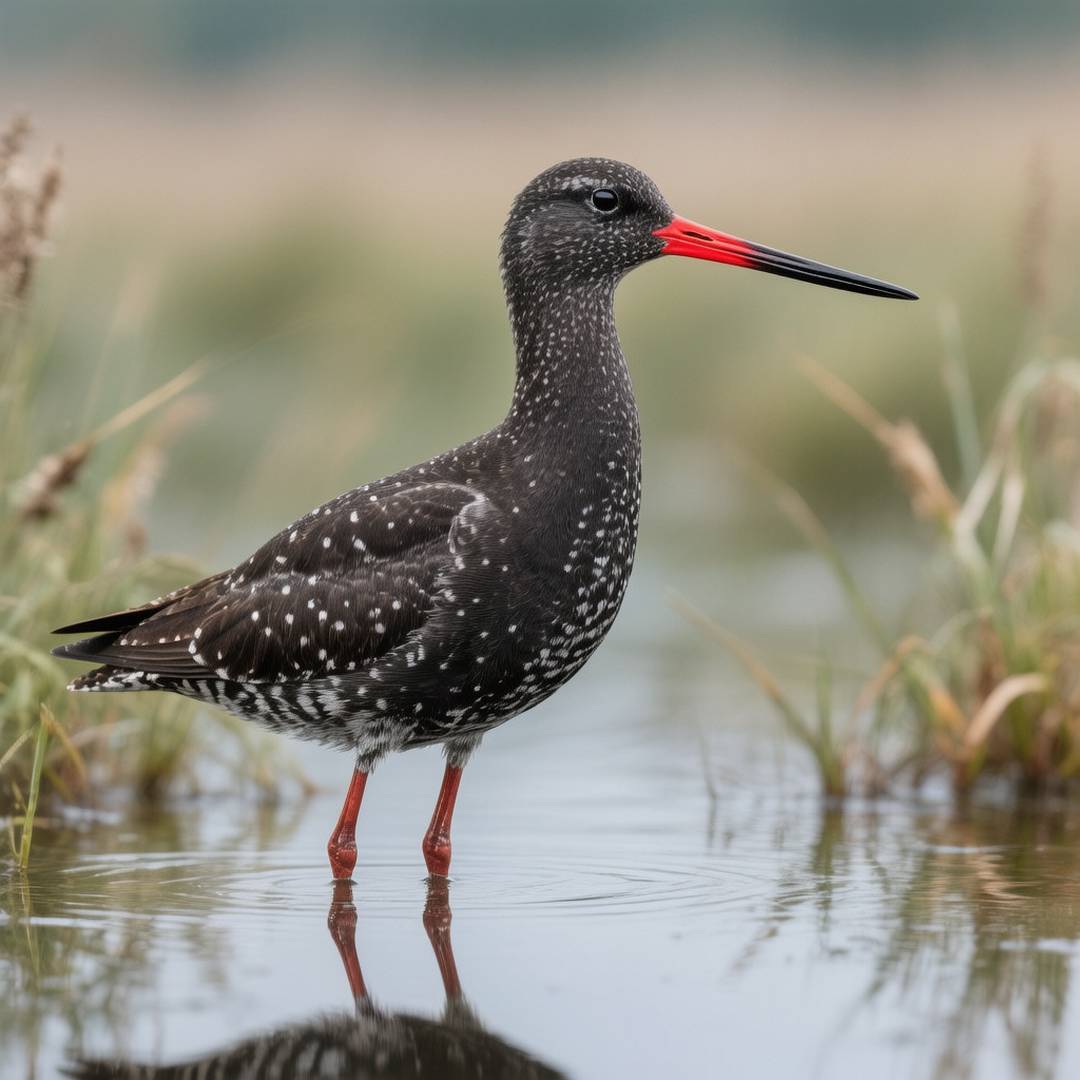
Spotted Redshank
The Spotted Redshank (Tringa erythropus) is slightly larger and more elegant. In summer, it is almost entirely black (the Common Redshank remains brown). In winter, it is very pale grey. Its bill is longer, finer, and only the lower mandible is red. In flight, it has no white wing bar.
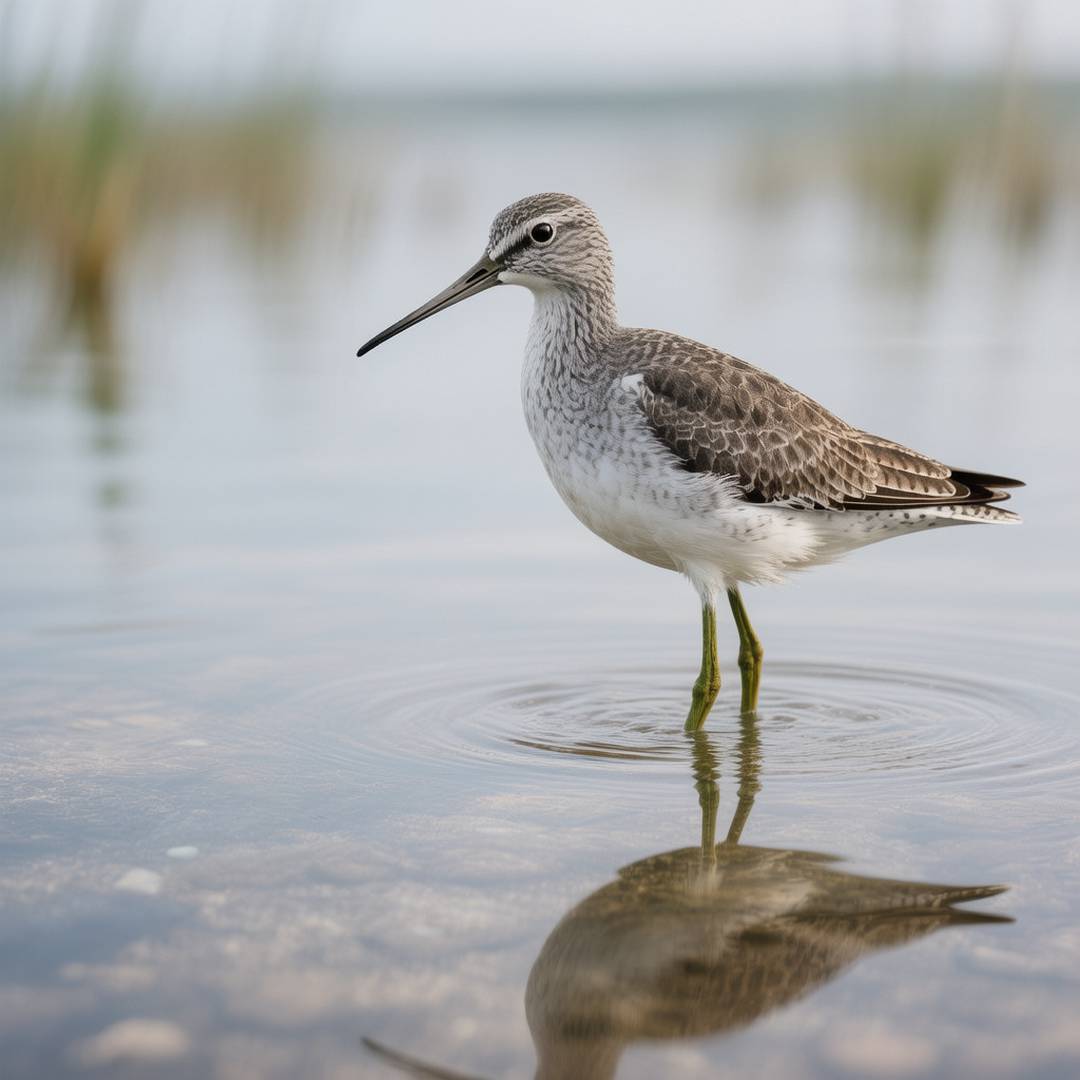
Common Greenshank
The Common Greenshank (Tringa nebularia) is larger and stockier. Its legs are green or grey-green, never red. Its bill is grey and slightly upturned. In flight, its wings are uniformly dark, without a white bar.
Song and Calls
The vocal repertoire of the Common Redshank is varied but always sonorous. It is a highly expressive bird.
Contact/Flight Call: A melodious, fluted "tyü-hü-hü", often descending in pitch.
Alarm Call: An insistent, nervous "kip-kip-kip", repeated tirelessly as long as the intruder is present. This call earns it the reputation of a sentinel.
Breeding Song: A series of rhythmic, rising yodeling notes, emitted during display flights over the territory: "tuli-tuli-tuli...".
0:00 / 0:00
Habitat and Distribution
The Common Redshank is widely distributed across temperate Eurasia. It frequents a wide variety of wetlands but shows a marked preference for coastal habitats.
Breeding Habitat: Wet grasslands, salt marshes, coastal marshes, and sometimes damp moors inland. It needs herbaceous vegetation tall enough to hide its nest.
Wintering Habitat: Intertidal mudflats, estuaries, coastal lagoons, and muddy shores. It is often seen in large flocks on mudflats at low tide.
Distribution Map
Present all year (Resident)
Breeding range
Wintering range (Non-breeding)
Passage area (Migration)
Diet
The Common Redshank feeds primarily on invertebrates. It paces across mudflats or shallow waters with a determined step. Its diet includes:
Marine worms (annelids).
Small crustaceans (shrimp, amphipods) and mollusks (Hydrobia snails).
Insects and their larvae (especially during the breeding season inland).
It hunts by sight, pecking at the surface, or by touch, probing soft mud with its sensitive bill.
Reproduction
Return to nesting sites occurs as early as March. The Common Redshank is monogamous for the season.
The Nest: A simple depression in the ground, well concealed in a tuft of tall grass. Grass blades are often pulled over to form a discreet canopy or tunnel.
Clutch: The female typically lays 4 spotted eggs between April and May.
Incubation: Lasts about 23-24 days, shared by both parents.
Rearing: The chicks are precocial: they leave the nest shortly after hatching. They are capable of feeding themselves but remain under the vigilant protection of the parents (especially the male towards the end) for about 25 to 30 days until fledging.
Conservation Status
Globally, the Common Redshank is classified as "Least Concern" (LC) by the IUCN. However, the situation is more concerning in Western Europe.
In many countries, breeding populations are declining, and the species is often considered Vulnerable locally. Key threats include:
Drainage of wetlands and conversion of grasslands to intensive agriculture.
Early mowing of meadows, which destroys nests and chicks.
Habitat loss due to coastal urbanization.
Frequently Asked Questions (FAQ)
Why does the Common Redshank have red legs?
The bright color of the legs, which intensifies in adults during the breeding season, likely plays a role in sexual selection and signaling the individual's good health to potential mates.
Where can I easily see the Common Redshank?
Estuaries, large bays, and coastal salt marshes are the best places, especially in winter and during migration, where they gather in the hundreds or thousands.