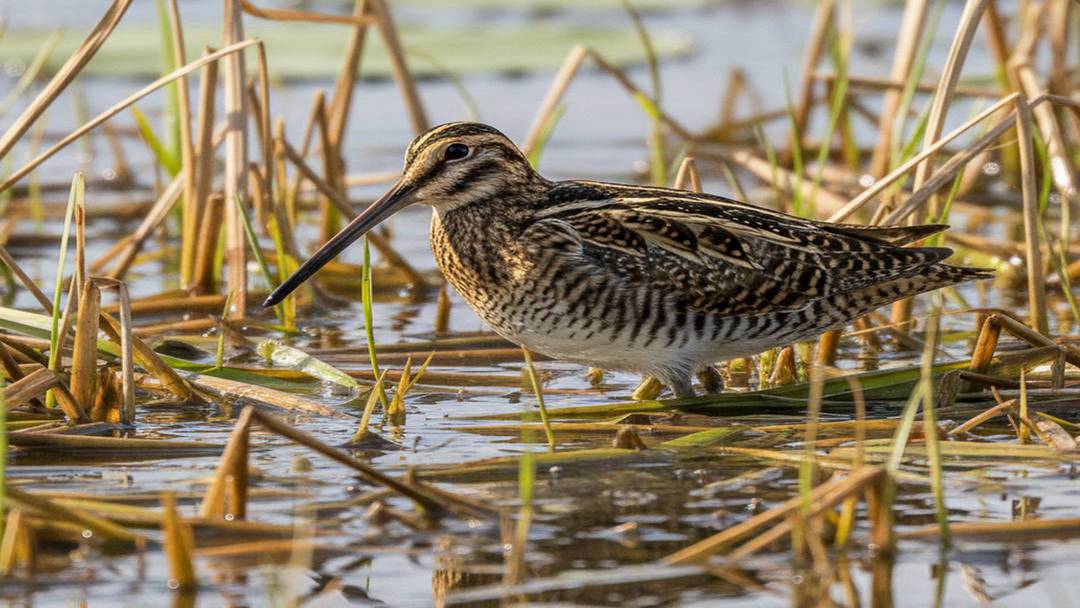
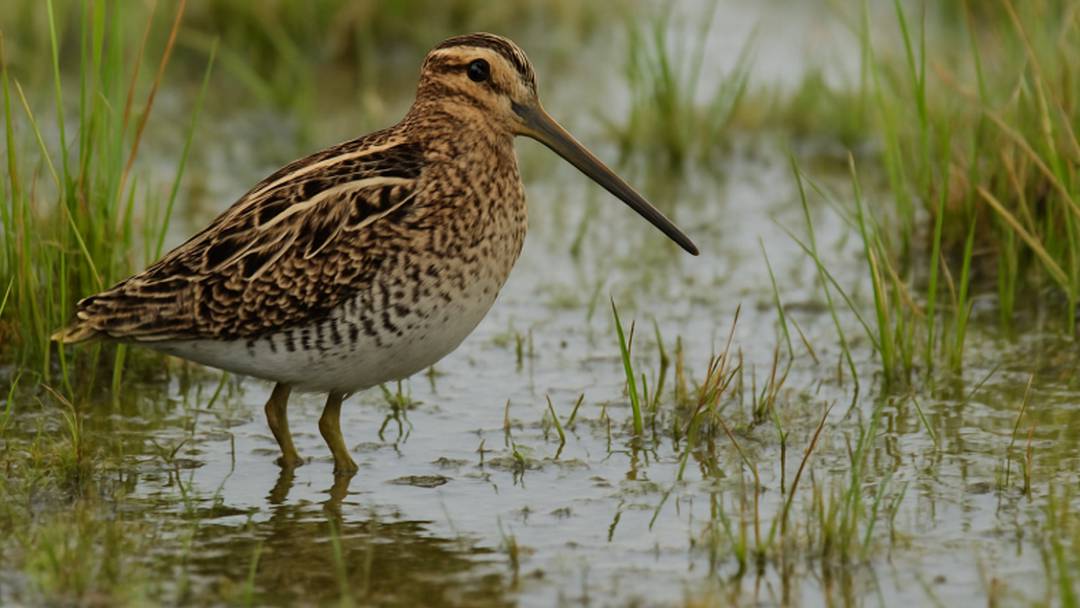
Its long straight bill is a precision tool for probing mud.
Introduction
The Common Snipe (Gallinago gallinago) is a small wading bird of the Scolopacidae family (sandpipers). Discreet and perfectly camouflaged, it is often detected only at the last moment when it flies off abruptly from the vegetation. Its dimensions are as follows:
Length: 25 to 27 cm (including the bill of about 6-7 cm)
Wingspan: 44 to 47 cm
Weight: 80 to 130 grams
This bird is famous for its rapid "zigzag" flight when frightened and for the unique mechanical sound, called "drumming," that the male produces with his tail during courtship displays. A typical inhabitant of wetlands and bogs, it uses its excessively long and sensitive bill to probe the mud for food.
Our Ornithologist's Advice
By the Les-Oiseaux.com team, published August 1, 2025.
My personal advice: The Common Snipe is a master of camouflage. It is very difficult to spot on the ground as long as it remains motionless.
The "Zigzag" Flight: This is the most reliable identification criterion in the field. If you are walking in a wet meadow and a brown bird flies off almost under your feet uttering a harsh "scap-scap" call and flying erratically (right-left-right) before gaining height, it is certainly a Common Snipe.
The Celestial "Drumming": In spring, look up! If you hear a vibrating sound resembling a bleating or repetitive humming coming from the sky, look for a small dot high in the air. It is the male performing dizzying dives, vibrating his outer tail feathers.
Unlike other waders that run on exposed mudflats, the snipe prefers to stay close to dense vegetation to hide quickly.
Have you observed the Common Snipe?
Share your experience and photos! Your observations enrich the Les-Oiseaux.com community.
You can share as a guest or create an account to track your contributions.
Identification
Identification of the Common Snipe relies on several morphological and behavioral criteria:
The Bill: It is extremely long (about twice the size of the head), straight, and brownish in color, darkening towards the tip. It is its main tool for probing the ground.
The Plumage: The back is dark brown, beautifully decorated with four clearly visible creamy or ochre longitudinal lines (the "braces"). The flanks are barred, and the belly is pure white. The head features characteristic stripes: a dark crown with a pale central stripe, and dark lines crossing the eye.
The Tail: Short, rufous with black markings and white tips.
In flight: The wings are pointed. One often notices the white trailing edge of the secondary wings (subtle criterion). The flight is fast, nervous, and typically zigzagging upon takeoff.
The creamy longitudinal lines on the back ("braces") are an excellent identification feature.
Dimensions and Scientific Data
Characteristic
Male
Female
Record / Average
Length
25 – 27 cm
25 – 27 cm
Includes bill (6-7 cm)
Weight
80 – 120 g
80 – 130 g
Variable depending on migration
Wingspan
44 – 47 cm
44 – 47 cm
Pointed wings
Flight Speed
60 – 100 km/h
60 – 100 km/h
Very fast on takeoff
Lifespan
-
-
Approx. 10-12 years (Max known: 19 years)
Song and Calls
The Common Snipe has a fascinating sound repertoire. When disturbed, it emits a dry, rasping call, phonetically "scap" or "chip", often repeated while zigzagging.
But its most spectacular manifestation is the drumming produced during the courtship display. This is not a vocal song, but a mechanical sound produced by the vibration of the outer rectrices (tail feathers) when the bird performs a rapid dive with its tail spread. It resembles a low, rhythmic bleating ("hoo-hoo-hoo-hoo") audible from a great distance.
0:00 / 0:00
Habitat and Distribution
The Common Snipe has a vast Holarctic distribution (North America, Europe, Asia). It is widely distributed, with numbers often increasing in winter due to migratory arrivals from the north.
Its preferred habitat is always linked to water and soft soils: bogs, marshes, wet meadows, muddy pond shores, rice paddies, and ditches. It requires soil soft enough to insert its long bill in search of food, and low vegetation (tussocks of sedge, rushes) for concealment.
Distribution Map
Present all year (Resident)
Breeding range
Wintering range (Non-breeding)
Passage area (Migration)
Diet
The Common Snipe is a "prober". It plunges its long bill vertically into soft mud, sometimes up to the base. The tip of its bill is flexible and extremely rich in nerve endings, allowing it to detect prey by touch without seeing it.
Its diet mainly consists of earthworms, insect larvae (such as crane flies), small crustaceans, mollusks, and sometimes aquatic plant seeds.
Reproduction
The breeding season begins with the famous aerial "drumming" displays of the males. The nest is built on the ground, always very well concealed in a clump of grass or rushes, often on an islet or an inaccessible zone. It is a simple depression lined with dry grass.
The female generally lays 4 pear-shaped eggs that are very cryptic, olive or brown spotted with black. Incubation lasts about 18 to 20 days, performed by the female alone. The chicks are nidifugous: they leave the nest a few hours after hatching. Interestingly, parents often split the brood, each taking care of 1 or 2 chicks to maximize their chances of survival.
Conservation Status
The Common Snipe is classified as "Least Concern" (LC) globally by the IUCN. However, breeding populations are declining in many parts of Western Europe. The main threat is the disappearance and degradation of its habitat: drainage of wetlands, drying of peat bogs, and agricultural intensification (conversion of wet meadows). In some regions, it is also a game bird.
Frequently Asked Questions (FAQ)
Does the Common Snipe sing with its mouth?
No, the most well-known sound (drumming) is mechanical. It is produced by the vibration of the outer tail feathers during a rapid dive. The air vibrates the feathers, creating this humming sound.
How to differentiate the Snipe from the Woodcock?
The Snipe lives in marshes (open habitat), is smaller, has longitudinal stripes on the head, and flies in a zigzag pattern. The Woodcock lives in forests, is larger, has transverse stripes on the head, and has a heavier flight.
Why is its bill so long?
Its bill acts as an ultra-sensitive probe. It allows the bird to reach for worms and larvae deeply buried in the mud, where other birds cannot reach them.