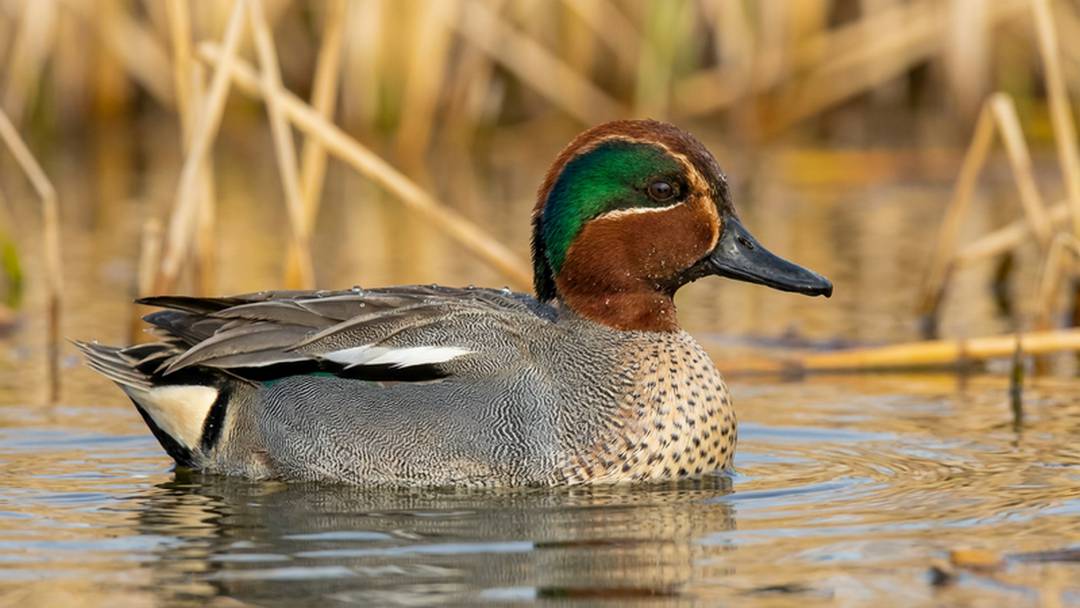
The male exhibits a striking chestnut head with an iridescent green mask.
Introduction
The Eurasian Teal (Anas crecca) is the smallest dabbling duck in Europe. Compact, agile, and gregarious, it is often seen in large flocks during winter. Its average dimensions are:
Length: 34 to 38 cm
Wingspan: 58 to 64 cm
Weight: 250 to 400 grams
Its scientific name crecca is onomatopoeic, derived from the characteristic "creck" or "prip" call of the male. It is a highly migratory species that animates wetlands with its nervous and rapid flight.
Our Ornithologist's Advice
By the Les-Oiseaux.com team.
My personal advice: When observing a group of ducks from a distance, look for the "miniatures."
Size difference: If you see ducks that look like Mallards but are half the size, they are likely Teals.
The yellow stern: On the male, look at the rear of the bird. A creamy-yellow triangular patch bordered by black is very visible, even from afar.
The horizontal stripe: A key detail to distinguish it from the rare American Green-winged Teal is the horizontal white stripe along the scapulars (shoulders).
In flight, they are incredibly agile, twisting and turning in unison like waders, which distinguishes them from the heavier flight of larger ducks.
Have you spotted a Eurasian Teal?
Share your experience and photos! Your sightings enrich the Les-Oiseaux.com community.
You can share as a guest or create an account to track your contributions.
Identification
Sexual dimorphism is distinct in the Eurasian Teal during the breeding season.
Adult Male (Breeding): Head is rufous-chestnut with a broad, iridescent green patch extending from the eye to the nape, bordered by a thin cream-yellow line. The body is grey with fine vermiculations. A horizontal white stripe runs along the shoulder (scapulars). The rear (stern) shows a distinctive creamy-yellow triangular patch bordered by black.
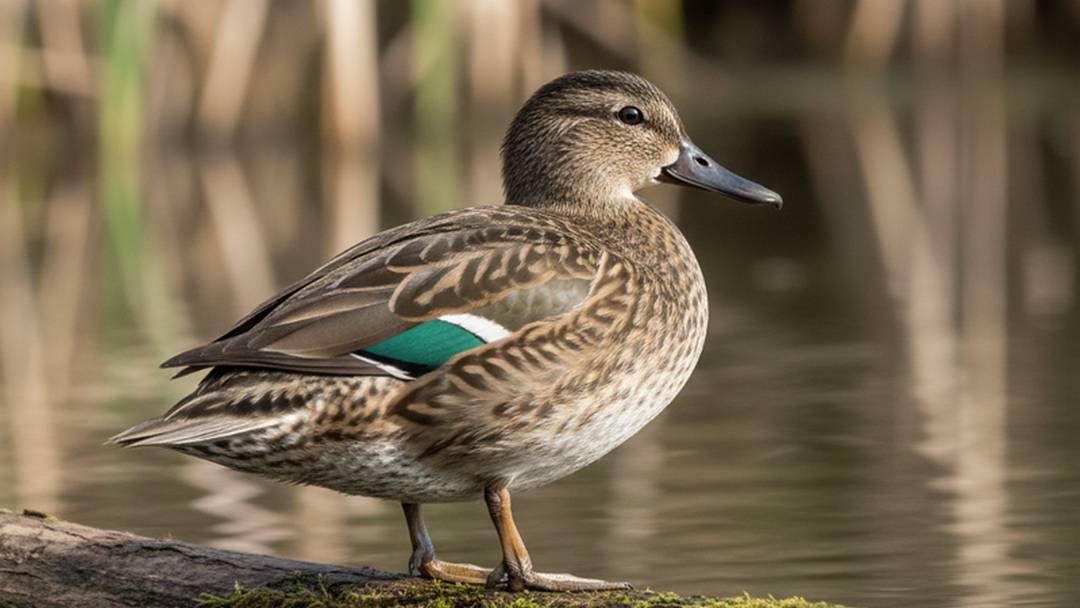
Female: Mottled brown overall, very similar to a female Mallard but much smaller. The best identification feature is the bright metallic green speculum (wing patch) bordered by white, often visible even when swimming.
Juvenile: Resembles the female but with more streaked underparts.
In Flight: Flight is fast, erratic, and agile. The green speculum bordered with white is conspicuous in both sexes.
The female is cryptic but identifiable by her small size and bill shape.
Dimensions (Eurasian Teal)
Characteristic
Data
Length
34 – 38 cm
Weight
250 – 400 g
Wingspan
58 – 64 cm
Lifespan
10 to 15 years
Not to be confused with...
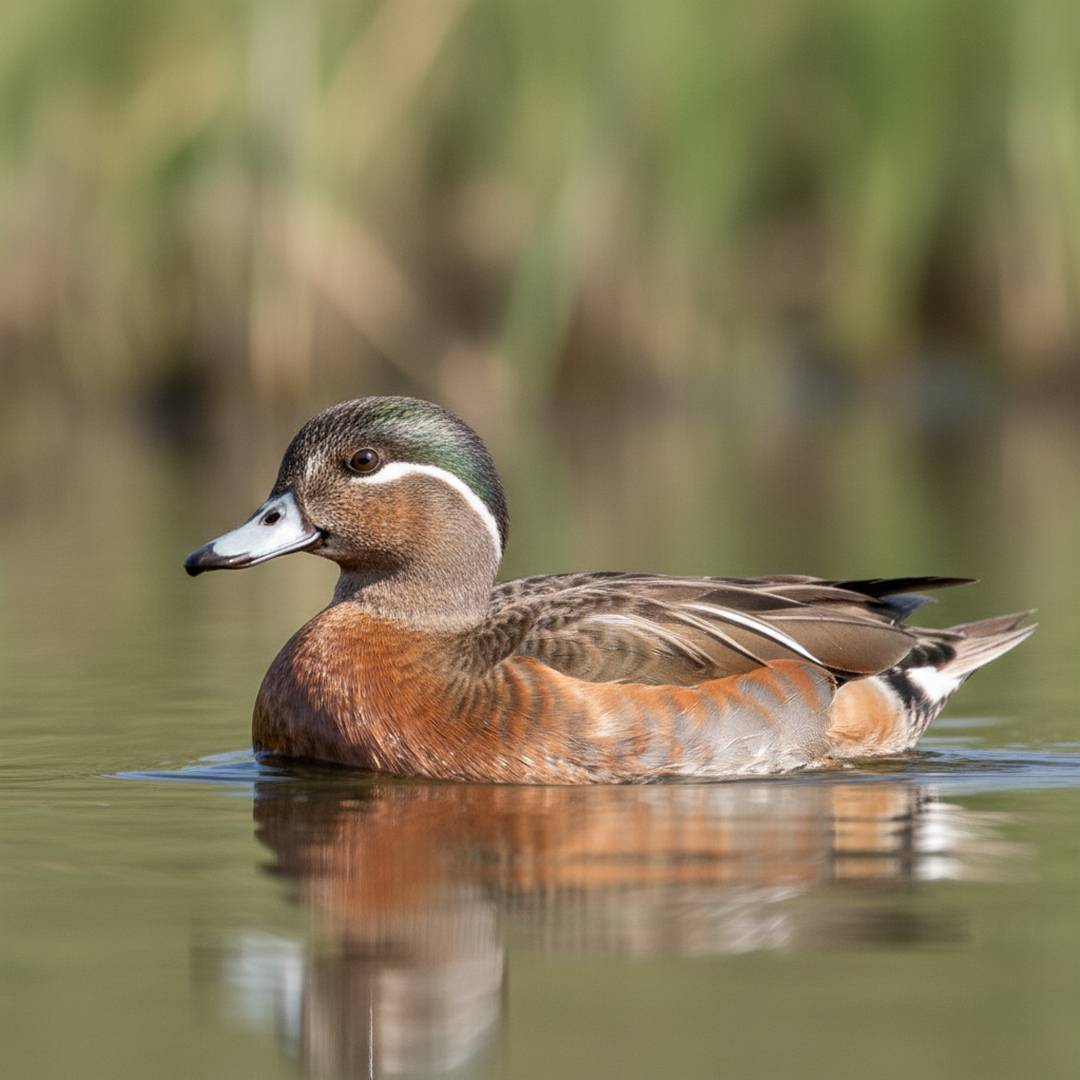
Garganey
Similar in size. The male Garganey has a reddish-brown head with a broad white supercilium (eyebrow) curving down the neck, not a green mask. The female has a more contrasted face pattern with a clearer eyebrow and a pale spot at the base of the bill.
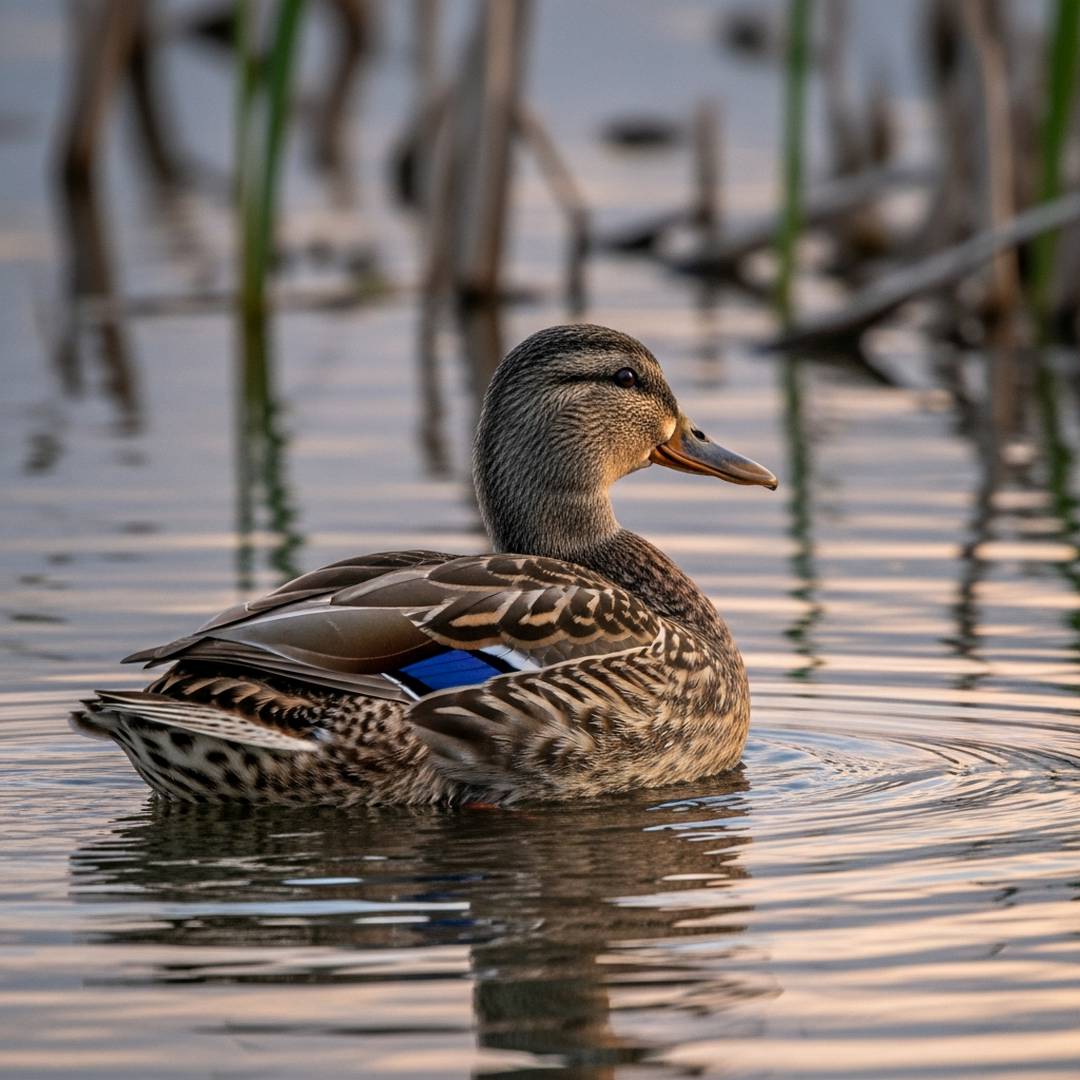
The female Eurasian Teal looks like a tiny female Mallard. The Mallard is roughly twice the size and has a blue-purple speculum, not a green one.
Song and Calls
The Eurasian Teal is quite vocal, especially in winter groups and during courtship. The male's call is one of the most distinctive sounds of European wetlands.
Male Call: A short, clear, liquid whistle sounding like "prip", "crick", or "krrrit". It carries far and is often heard in chorus.
Female Call: A high-pitched, nasal "kwek-kwek", higher and faster than a Mallard's quack.
0:00 / 0:00
Habitat and Distribution
The Eurasian Teal is widespread across the Palearctic.
Breeding: Prefers small, quiet freshwater pools, peat bogs, and marshes with abundant vegetation cover, often in boreal or temperate zones.
Wintering: Migrates to milder climates in Western and Southern Europe, Africa, and South Asia. In winter, it congregates on coastal marshes, estuaries, lagoons, and flooded fields. It favors shallow waters where it can feed by dabbling.
Distribution Map
Present all year (Resident)
Breeding range
Wintering range (Non-breeding)
Diet
The Eurasian Teal is omnivorous with a diet that varies by season. It feeds primarily by "dabbling" (filtering surface water) or tipping up, rarely diving.
Seeds: In winter, seeds of aquatic plants (sedges, pondweeds, grasses) make up the bulk of its diet.
Invertebrates: In summer and during the breeding season, it consumes more animal protein, including small mollusks, crustaceans, worms, and insect larvae (midges, beetles).
Its small bill is perfectly adapted for filtering mud in shallow waters.
Reproduction
Unlike the cavity-nesting Goldeneye, the Teal nests on the ground.
The Nest: It is built on the ground, well hidden in dense vegetation (heather, ferns, tall grasses), usually near water but sometimes at a distance to avoid flooding. It is lined with down.
Clutch: The female lays 8 to 11 creamy or pale buff eggs from mid-April to May.
Incubation: The female incubates alone for 21 to 23 days. The male leaves the female once incubation begins to molt.
Rearing: The ducklings are precocial and leave the nest shortly after hatching. The female leads them to water and protects them until they fledge at about 25-30 days.
Conservation Status
The Eurasian Teal is classified as "Least Concern" (LC). It has an extremely large range and a very large population.
However, wetland drainage and habitat loss remain threats. It is also a huntable species in many countries, but populations appear stable or fluctuating depending on winter harshness.
Frequently Asked Questions (FAQ)
What is the "teal" color?
The color "teal" (a medium to deep blue-green) is named after the colored eye patch of this bird and the speculum on its wings. It was first used as a color name in English in 1917.
Does the Eurasian Teal migrate?
Yes, northern populations are strongly migratory, moving south and west to escape freezing waters. Populations in milder Western Europe (like the UK or France) may be resident or make shorter movements.