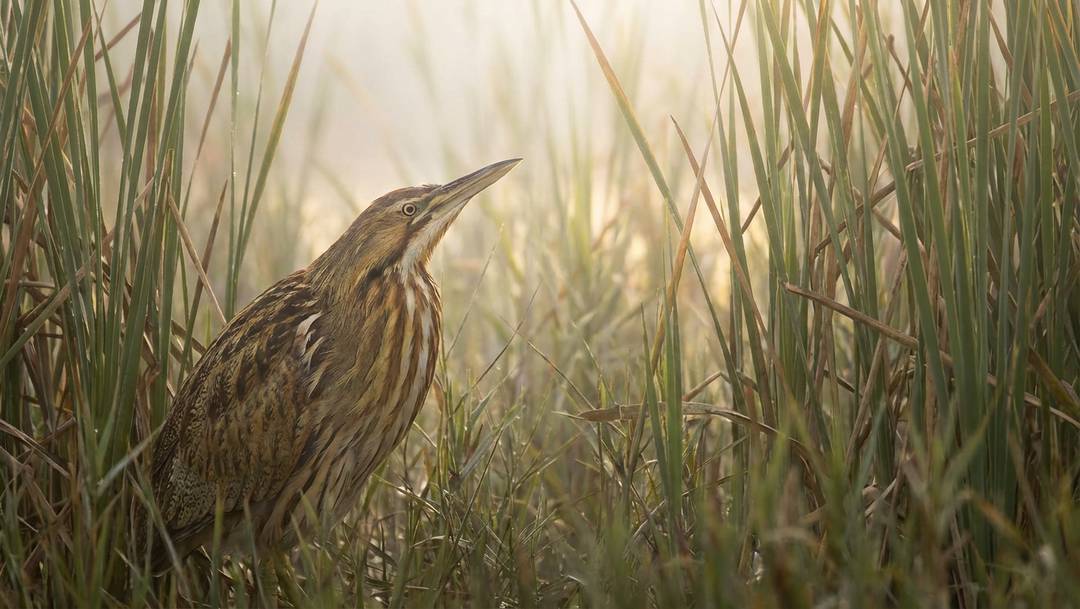
The plumage mimics the play of light and shadow in a reedbed.
Introduction
The Great Bittern (Botaurus stellaris) is a thick-necked, golden-brown heron, famous for its secretive nature. It is the ghost of the wetlands, rarely seen but often heard thanks to the male's deep booming call that resonates like a foghorn across the marshes. Its average dimensions are:
Length: 70 to 80 cm
Wingspan: 125 to 135 cm
Weight: 0.9 to 1.9 kg
Unlike the Grey Heron which often stands in the open, the Bittern relies entirely on camouflage. Its scientific name stellaris (starry) refers to the speckled and streaked pattern of its plumage.
Our Ornithologist's Advice
By the Les-Oiseaux.com team.
My personal advice: Seeing a Bittern requires patience and luck, but you can increase your odds.
The "Boom": In spring (March to May), prioritize your ears. The male's booming call is unmistakable. If you hear it, scan the base of the reeds carefully.
Flight paths: Bitterns are most visible when flying between feeding grounds, often at dawn or dusk. Look for a broad-winged, owl-like silhouette flying low over the reeds with a tucked-in neck.
Winter freeze: During harsh winters when water freezes, Bitterns are forced out of the cover to find ice-free patches. This is often the best time to see them in the open.
Have you spotted a Great Bittern?
Share your experience and photos! Your sightings enrich the Les-Oiseaux.com community.
You can share as a guest or create an account to track your contributions.
Identification
Unlike many ducks, there is no significant sexual dimorphism in plumage between male and female.
Plumage: Golden-brown overall, heavily streaked and barred with black. The neck shows longitudinal stripes that mimic reed stems. It has a black crown and a black "moustache" stripe.
Structure: A bulky body with a thick neck. The legs are pale green. The bill is dagger-like, yellowish-green.
The "Bitterning" Posture: When threatened, it freezes, stretches its neck vertically, and points its bill upwards. It may even sway gently with the wind to blend in with the moving reeds.
In Flight: The wings are broad and rounded. It flies with the neck retracted (like all herons), but the head looks thicker and less protruding than a Grey Heron. The flight is faster with shallower beats.
In flight, it can resemble an owl due to its broad, rounded wings.
Dimensions (Great Bittern)
Characteristic
Data
Length
69 – 81 cm
Weight
900 – 1,900 g
Wingspan
125 – 135 cm
Lifespan
Up to 11 years
Not to be confused with...
Grey Heron
Much more common and often seen in open fields. It is taller, distinctly grey and white (not brown), with a much longer, thinner neck. It does not hide in reeds as strictly as the Bittern.
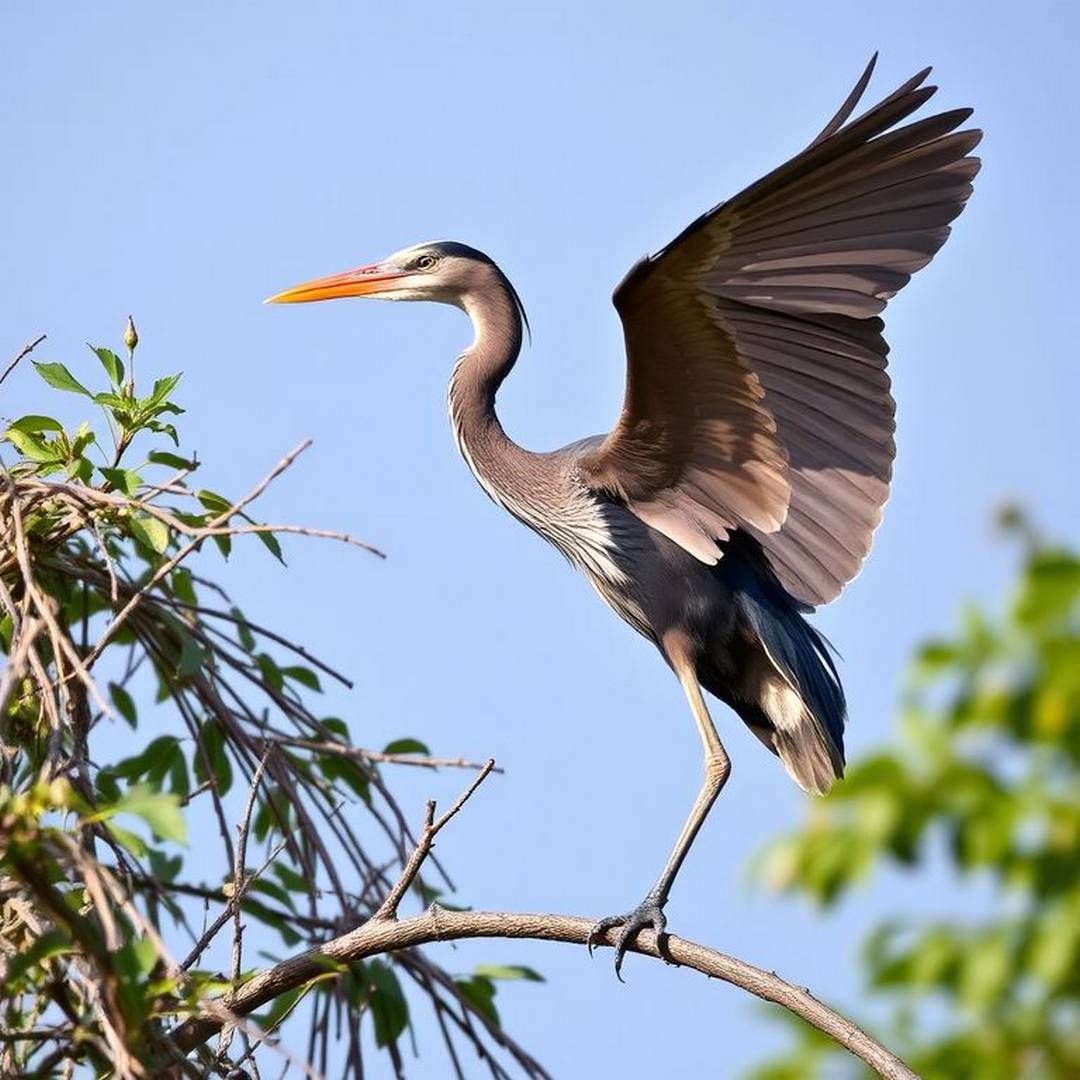
Similar habitat, but slimmer and darker. The Purple Heron has a very thin, snake-like neck with reddish-brown coloration. In flight, its feet project noticeably further behind the tail than the Bittern's.
Song and Calls
The Great Bittern is famous for its male's territorial call, known as the "boom".
The Boom: A deep, resonant sound resembling distant thunder or a foghorn blowing into a bottle ("whooomp"). It is repeated 3 to 5 times. To produce this sound, the male inflates his esophagus, acting as a resonance chamber.
Other sounds: In flight, it may give a harsh, nasal "gau" or "kua" if startled.
0:00 / 0:00
Habitat and Distribution
The Great Bittern is strictly dependent on extensive wetlands.
Breeding: Requires large, undisturbed reedbeds (Phragmites) standing in shallow water. It needs old reeds for cover and open water pools for fishing.
Wintering: Populations from Northern and Eastern Europe migrate south and west to find ice-free water. They can be found in smaller wetlands, gravel pits, or reservoirs, provided there is some reed cover.
Distribution Map
Present all year (Resident)
Breeding range
Wintering range (Non-breeding)
Diet
The Great Bittern is a formidable ambush predator. It hunts by standing motionless or walking very slowly in shallow water.
Fish (Eels are a favorite, as well as Roach, Pike, etc.).
Amphibians (Frogs, Newts).
Aquatic insects and crustaceans.
Occasionally small mammals (voles) or nestlings of other birds.
It strikes with lightning speed, using its sharp bill to spear or grab its prey.
Reproduction
The breeding season starts with the male's booming calls in early spring to establish territory.
The Nest: A floating platform of old reed stems, built by the female deep within the densest reeds, often just above water level.
Polygamy: Males are often polygamous, mating with up to five females if food resources are abundant. The male does not help with incubation or raising the young.
Clutch: 4 to 6 olive-brown eggs are laid in April-May. Incubation takes about 25 days.
The Young: The chicks are fed by the female (regurgitation). They leave the nest at 2-3 weeks to hide in the surrounding vegetation but cannot fly until they are about 8 weeks old.
Conservation Status
The Great Bittern is listed as "Least Concern" globally due to a wide range, but regional populations (especially in Western Europe) have historically suffered sharp declines due to the drainage of wetlands and destruction of reedbeds.
Conservation efforts, focusing on habitat restoration and water level management in reedbeds, have allowed populations to recover in countries like the UK and France.
Frequently Asked Questions (FAQ)
Why does the Bittern point its beak at the sky?
This is a defensive camouflage technique. By stretching vertically, it exposes the dark stripes on its neck, which visually merge with the vertical lines of the reed stems. It even sways to mimic reeds blowing in the wind.
Can I see a Bittern in a garden pond?
It is extremely unlikely. The Great Bittern requires extensive reedbeds to feel safe. During severe winters, starving individuals might appear in unusual open places, but a garden pond is not their habitat.