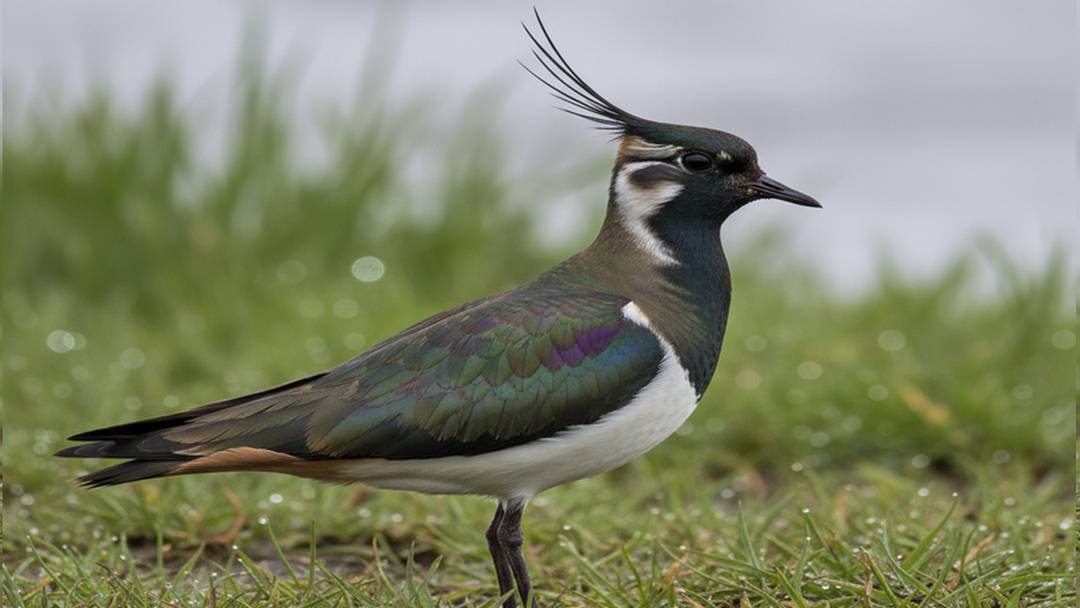
The male Northern Lapwing is striking with its long, thin crest and metallic plumage.
Introduction
The Northern Lapwing (Vanellus vanellus), also known by its evocative nickname 'Peewit', is a distinctive and handsome wader belonging to the plover family. It is easily recognized by its long, elegant black crest and the striking iridescent green sheen on its black upperparts. Once common across European farmland, it is an important indicator of grassland health. Its average dimensions are:
Length: 28 to 31 cm
Wingspan: 70 to 80 cm
Weight: 128 to 330 grams
Its scientific name, Vanellus, is derived from Latin, meaning "fan" or "winnowing," referring to its characteristic slow, deliberate, flapping flight.
Our Ornithologist's Advice
By the Les-Oiseaux.com team.
My personal advice: The Lapwing is one of the most recognizable birds in the field, but its identification relies as much on its behavior as its appearance.
Listen for the Call: In winter flocks or during spring displays, the Lapwing's call is unmistakable. The melancholy, two-note "pee-wit!" gives it its nickname and is often the first sign of a flock.
Observe the Flight: Look for its broad, rounded wings in flight. It has a floppy, hesitant wingbeat that is very different from other waders, especially during its spectacular aerial display, where it tumbles and dives over the breeding ground.
Lapwings are most often seen in open, damp fields, probing the soft soil. In winter, large flocks often form on estuaries or freshly ploughed land.
Have you spotted a Northern Lapwing?
Share your experience and photos! Your sightings enrich the Les-Oiseaux.com community.
You can share as a guest or create an account to track your contributions.
Identification
The Northern Lapwing is relatively unique among European waders. Both sexes look similar, but the male's crest is slightly longer and the black bib is more distinct in breeding plumage.
Adult (Breeding): Upperparts are an iridescent, metallic green/black, contrasting sharply with the white belly. The long, thin black crest trails from the back of the head. The breast has a black bib. The most noticeable feature in flight is the chestnut/orange-rufous colour of the undertail coverts (just below the tail).
Female: Similar to the male, but the head pattern is less crisp, and the crest is slightly shorter.
Juvenile/Winter: Duller overall, with less defined dark areas. The crest is shorter. The pale edges on the back feathers give a 'scaly' appearance.
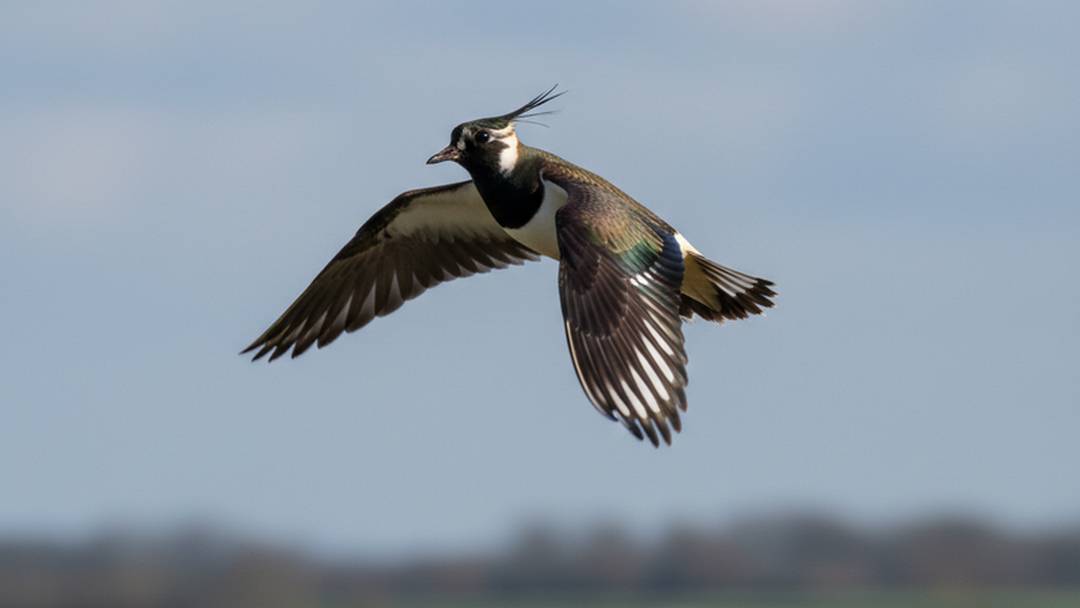
In Flight: The broad, rounded wings, slow wingbeats, and the distinct colour pattern—especially the white underside with the orange undertail—make it instantly identifiable.
In flight, the Lapwing's broad, rounded wings are unmistakable.
Dimensions (Northern Lapwing)
Characteristic
Data
Length
28 – 31 cm
Weight
128 – 330 g
Wingspan
70 – 80 cm
Lifespan
Up to 12 years
Not to be confused with...
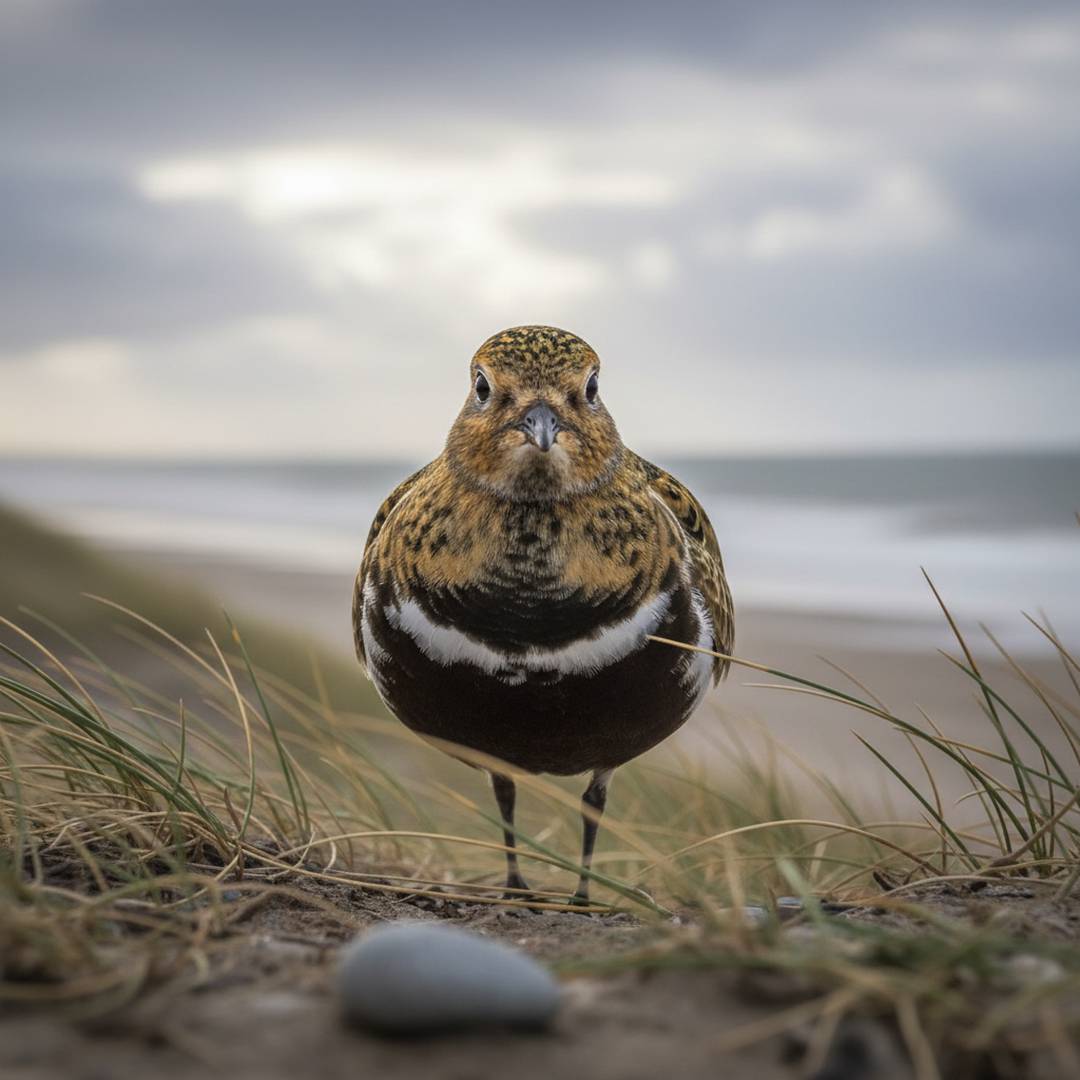
European Golden Plover
Similar size and habitat, but lacks the distinctive crest. The Golden Plover's back is flecked with golden-yellow and it has a more compact, round-headed shape.
Grey Plover
Stockier and more short-necked than the Lapwing. Its winter plumage is heavily speckled grey and white, and it lacks the long crest and the strong green iridescence of the Lapwing's back.
Song and Calls
The Lapwing is vocal, especially during the breeding season. Its distinctive call is the source of its most common nickname.
Main Call (Peewit): A clear, mournful, rising two-note call, "pee-wit... pee-wit!" often given repeatedly, particularly in flight.
In Flight: The wings produce a low, whirring or rattling sound, but not the clean 'whistle' of species like the Goldeneye.
Alarm: A series of short, rasping or grating notes when a predator is near the nest.
0:00 / 0:00
Habitat and Distribution
The Lapwing is found across the temperate and boreal regions of Eurasia. It is a lowland bird strongly associated with open, wet landscapes.
Breeding: Prefers wide, open areas like damp pastures, newly sown fields, moorland, and fallow land, usually close to water.
Wintering: Forms large flocks (sometimes thousands strong) on coasts, estuaries, flooded fields, and agricultural land, often in mixed flocks with other waders. Western European populations are largely resident, while Northern and Eastern populations migrate south-west for the winter.
Distribution Map
Present all year (Resident)
Breeding range
Wintering range (Non-breeding)
Passage area
Diet
The Northern Lapwing is a carnivore that feeds almost exclusively on small invertebrates found in or just below the soil surface. Its diet includes:
Earthworms and larvae.
Aquatic and terrestrial insects (beetles, craneflies).
Spiders and snails.
Occasionally, seeds, especially in harsher weather.
It typically uses a 'stop-start' method, running across the ground, stopping to scan, and then quickly probing the soil with its short bill to extract prey.
Reproduction
As a ground-nesting species, the Lapwing's breeding success is highly dependent on suitable habitat and low predation.
The Nest: The nest is a simple scrape on the ground, lined with small pieces of vegetation, often located in areas of short vegetation or young crops. The male initiates several scrapes, and the female chooses the final site.
Clutch: The female lays 4 pear-shaped, olive-brown, spotted eggs between March and May. Both parents share the incubation, which lasts between 21 and 28 days.
The Young: The chicks are precocial, meaning they are active and able to leave the nest shortly after hatching. They are hidden among the vegetation by the female while the male often defends the territory, using distraction displays to lure away intruders.
Conservation Status
The Northern Lapwing is currently classified as "Near Threatened" (NT) globally. Its populations have undergone significant declines across much of its European range, particularly in the UK and Western Europe.
The primary threats include changes in agricultural practices (e.g., earlier mowing of silage grass, draining of wet pastures) and habitat loss. Conservation efforts focus on managing farmland to provide suitable breeding and feeding grounds.
Frequently Asked Questions (FAQ)
Why is the Northern Lapwing called 'Peewit'?
The name 'Peewit' is onomatopoeic, derived directly from its very characteristic and often repeated call, a melancholy, rising 'pee-wit'.
What is the Lapwing's striking aerial display?
The male performs an impressive tumbling, fluttering flight display, accompanied by its call, often described as 'tumbling' or 'whirling,' which is part of its courtship ritual over the breeding grounds.
How does the Lapwing defend its nest?
The Lapwing employs a 'distraction display' in which it flies low over a predator, drawing attention to itself and away from the ground nest. It may also perform low-level dives or appear to have a broken wing to lure the intruder away.