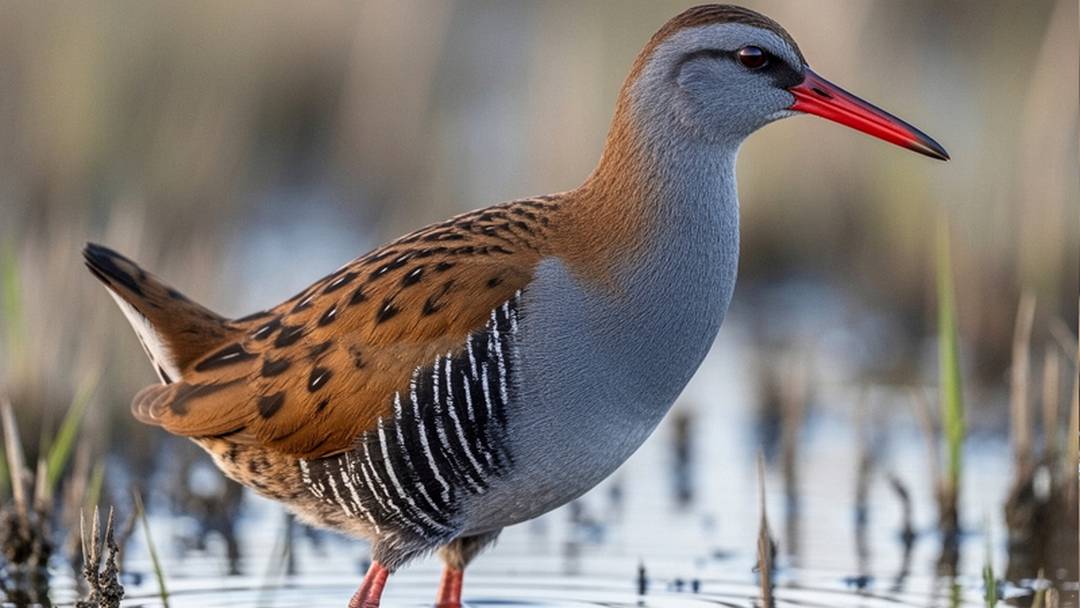
The Water Rail is notoriously shy, recognized by its long red bill and barred flanks.
Introduction
The Water Rail (Rallus aquaticus) is a highly secretive wading bird belonging to the rail family. Small and compact, it is a master of hiding, preferring to slip silently through dense reedbeds and marsh vegetation rather than take flight. It is more often heard than seen, thanks to its distinctive, loud calls.
Length: 23 to 28 cm
Wingspan: 38 to 45 cm
Weight: 90 to 190 grams
Its scientific name, Rallus aquaticus, simply means "aquatic rail," a perfect description of its preferred habitat in freshwater marshes across Europe, North Africa, and Asia.
Our Ornithologist's Advice
By the Les-Oiseaux.com team.
My personal advice: Observation of the Water Rail is a matter of immense patience and opportunity.
Listen for the 'Sharming': You must learn its voice! The pig-like squeals (the 'sharming' call) are the key identification tool. They are most frequent at dawn, dusk, and even on moonlit nights, often betraying its location when it’s impossible to see.
Observe the Edges: The best chances for a sighting are to patiently watch the narrow, muddy edges of reedbeds or patches of open water within dense cover, particularly on a cold, frosty morning when the bird might venture out for a moment to feed or sunbathe.
When it does show itself, observe its movement: it runs with a characteristic low-slung body and often jerks its short tail up, revealing the white undertail coverts.
Have you spotted a Water Rail?
Share your experience and photos! Your sightings enrich the Les-Oiseaux.com community.
You can share as a guest or create an account to track your contributions.
Identification
The Water Rail has a sleek appearance, adapted for threading through dense vegetation. Sexual dimorphism is subtle, with the male and female looking very similar, though the male tends to be slightly larger.
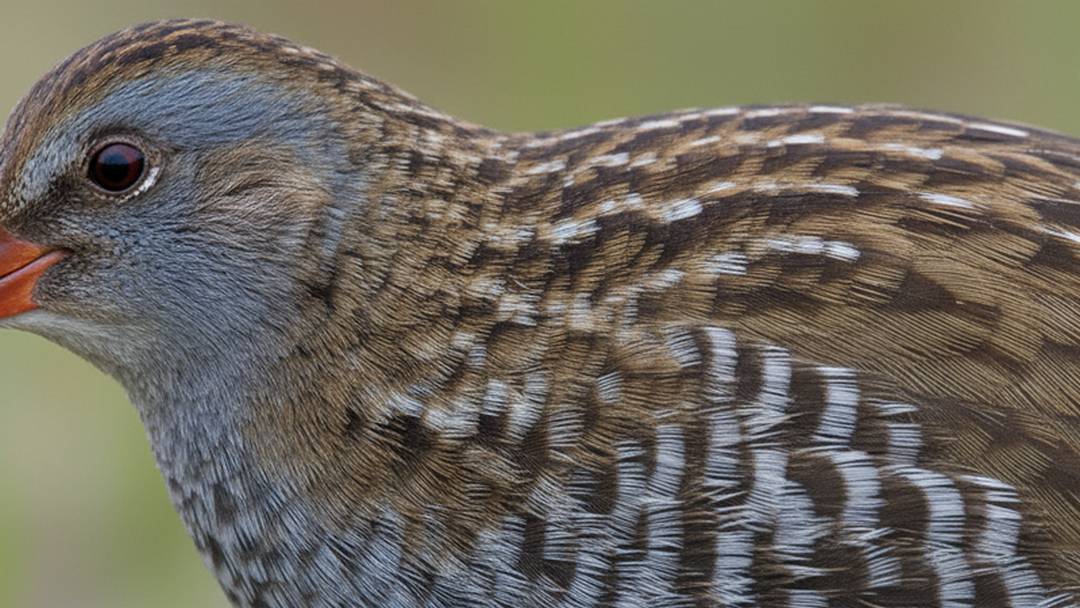
Adult: Characterized by a long, slender, red bill with a darker tip. The face, neck, and breast are slate-grey to bluish-grey. The back and wings are brown with black streaking. The flanks show striking and diagnostic black and white barring. The undertail is white, and the legs are greenish-brown.
Juvenile: The grey plumage of the face and chest is replaced by a dull buff or brown colouration. The barring on the flanks is less distinct, and the bill is dark, often lacking the adult's prominent red colour.
In Flight: Flight is weak, hesitant, and short, usually with dangling legs, performed only when strictly necessary. The short, rounded wings are visible.
The black and white barring on the flanks is the most distinctive plumage feature.
Dimensions (Water Rail)
Characteristic
Data
Length
23 – 28 cm
Weight
90 – 190 g
Wingspan
38 – 45 cm
Lifespan
Up to 8 years
Not to be confused with...
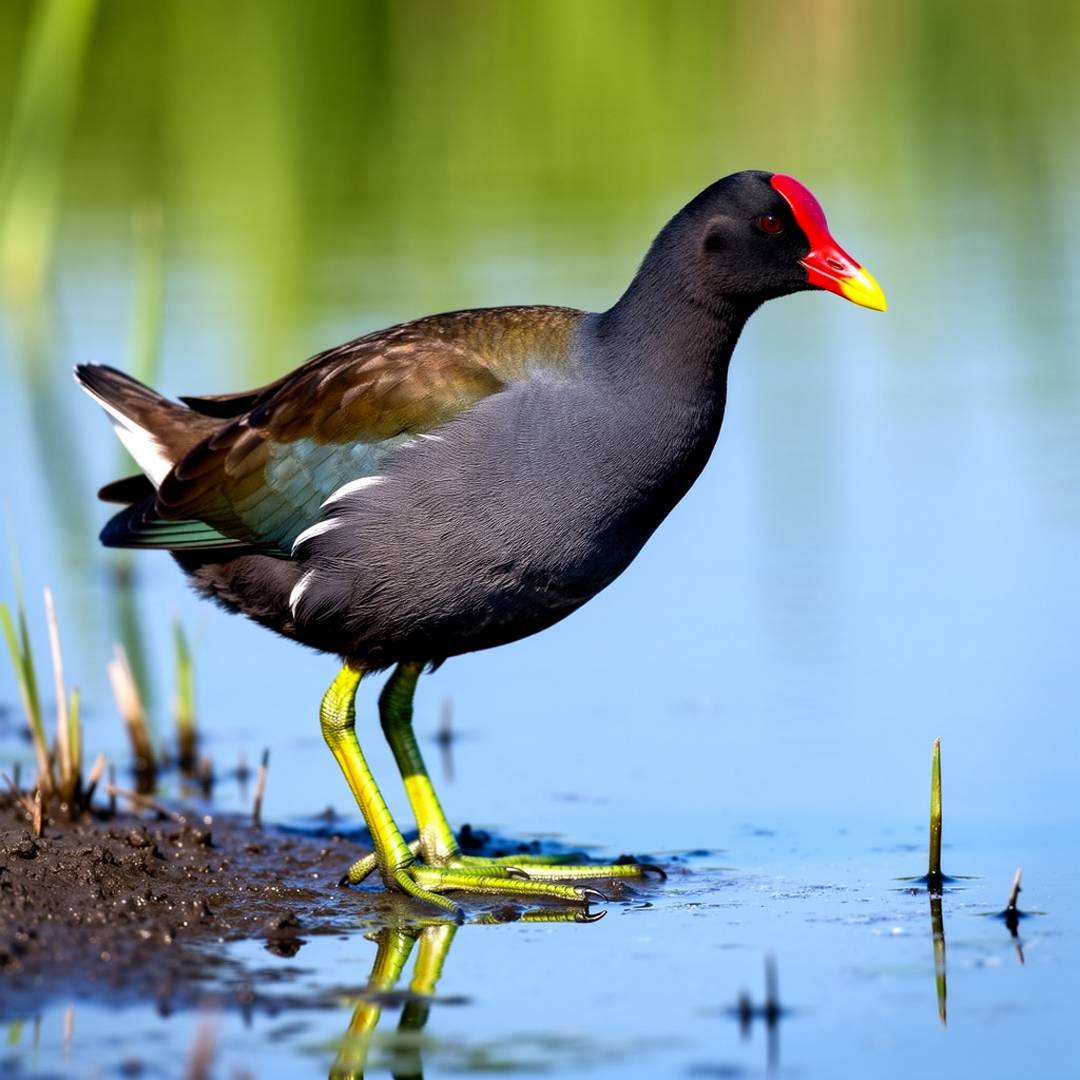
Common Moorhen
Much more visible and less shy. It has a short, thick, red bill with a yellow tip and a red frontal shield. It has a plain grey body with a clean white stripe on the flank, not the black and white barring of the Water Rail.
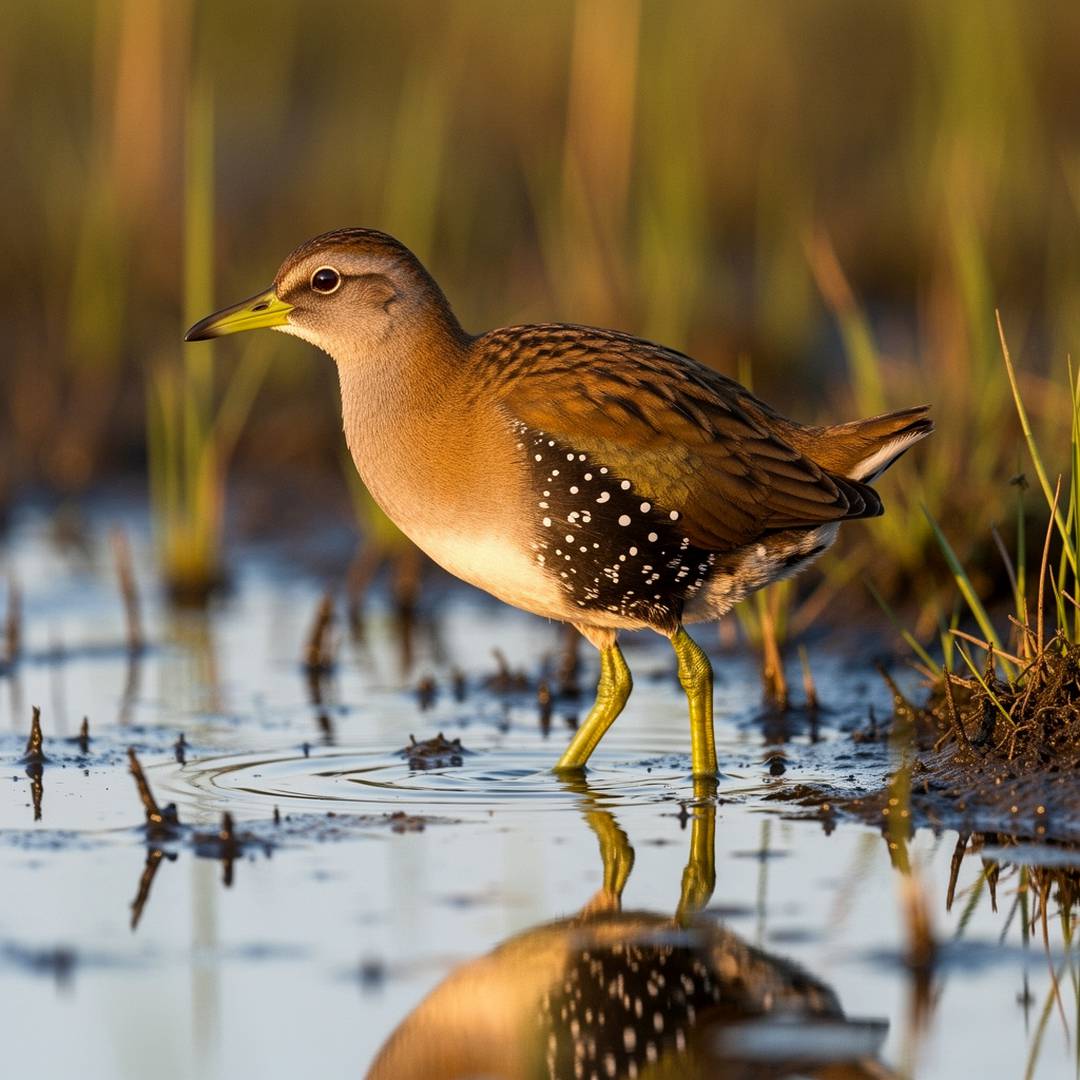
Similar habitat, but smaller. It has a short, thick yellowish-green bill with a red base, and is spotted white on the breast and flanks (not barred). It also lacks the Water Rail's clean grey face.
Song and Calls
The Water Rail is perhaps best known for its startling and noisy calls, often given from the depths of its cover, making them appear mysterious to the casual observer. It is much quieter during the day.
The 'Sharming' Call: The most frequent and unmistakable call is a descending, loud series of squealing notes, often likened to the sound of a distressed pig or a high-pitched snore: "shiiik-shik-shik-shik".
Alarm Call: A sharper, explosive "kip-kip-kip" when disturbed.
Wing Sound: Virtually silent in flight, unlike many other rails.
0:00 / 0:00
Habitat and Distribution
The Water Rail is a widespread species throughout the temperate and boreal wetlands of the Old World, from Europe to North Africa and Asia.
Habitat: It strictly requires dense, tall wetland vegetation. This includes reedbeds, sedge marshes, well-vegetated ditches, peat bogs, and overgrown river banks. It often prefers a muddy or wet base.
Distribution: Northern and eastern populations are migratory, moving southwest for the winter. Resident populations exist in warmer, western parts of Europe (e.g., UK, Iberia).
Distribution Map
Present all year (Resident)
Breeding range
Wintering range (Non-breeding)
Diet
The Water Rail forages actively in mud and shallow water, using its long bill to probe for food.
Invertebrates: Its main diet consists of aquatic insects (larvae and adults), worms, leeches, and small mollusks.
Small Prey: It occasionally takes small fish, amphibians, and even small mammals.
Plant Matter: Seeds and berries from marsh plants are consumed, particularly during autumn and winter.
It can be quite predatory, sometimes taking eggs or nestlings of other small wetland birds if the opportunity arises.
Reproduction
The Water Rail's nest is as secretive as the bird itself, well-hidden deep within its marshy habitat.
The Nest: Built by both sexes, it is a bulky, deep cup made of dead leaves and stems of rushes, sedges, or reeds, cleverly concealed just above the water level or on a small tussock. The surrounding vegetation is often woven to form a protective canopy.
Clutch: The female typically lays 6 to 11 pale, spotted eggs between April and July, often producing two clutches in a season. Both parents share the incubation, which lasts about 19 to 21 days.
The Young: Hatchlings are covered in black down, fully precocial, and are cared for by both parents. They leave the nest quickly (often within days) but remain dependent for several weeks.
Conservation Status
The Water Rail is globally classified as "Least Concern" (LC) by the IUCN Red List. It has a very large range and a seemingly large, though difficult to monitor, population.
The primary threat to the Water Rail is the loss and degradation of its wetland habitat due to drainage, pollution, and intensive water management. Local populations can fluctuate significantly based on the quality and extent of dense reedbed cover.
Frequently Asked Questions (FAQ)
Can the male and female be confused?
Yes, in the field, the male and female Water Rail are extremely difficult to distinguish as their plumage is essentially identical (a case of monomorphism). The male is statistically slightly larger, but this is not an identification feature.
Does the Water Rail fly long distances?
While most of its movement is on foot, northern and eastern populations are strong, long-distance migrants. Their apparent reluctance to fly is mainly a local anti-predator strategy; they fly high and well when migrating.
What is the bird's posture when running?
When running, it holds its body low, slightly hunched, using its thin, powerful legs to move quickly through dense cover. It rarely runs in the open, preferring the protection of tall vegetation.