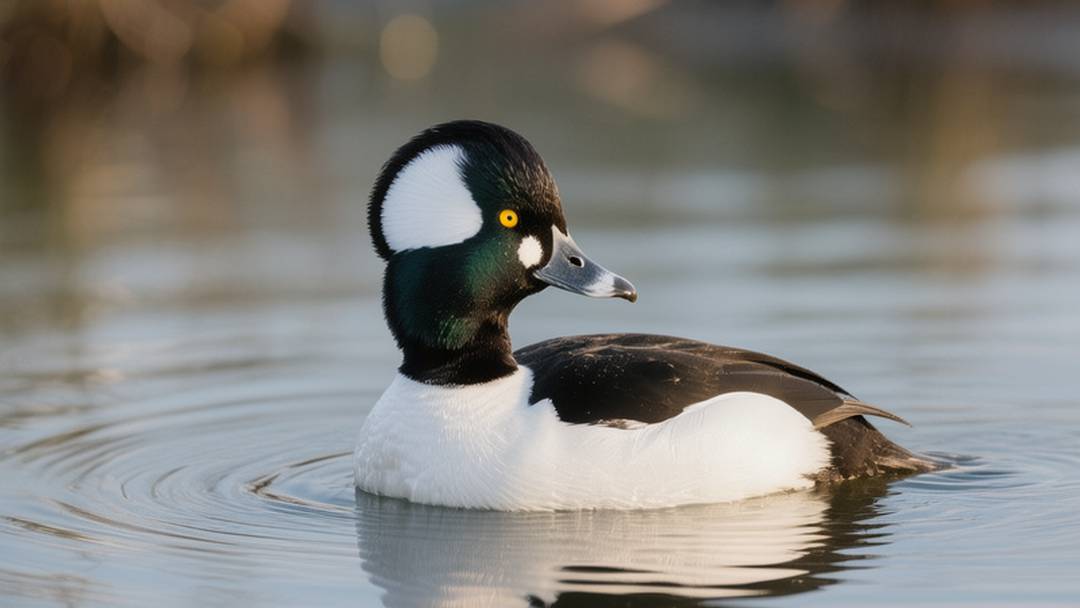
The breeding male shows a striking contrast of black and white.
Introduction
The Common Goldeneye (Bucephala clangula) is a medium-sized diving duck, compact with a massive head. An emblem of boreal forests and Scandinavian lakes, it commonly winters on large bodies of water and coasts of Western Europe. Its average dimensions are:
Length: 42 to 50 cm
Wingspan: 65 to 80 cm
Weight: 500 to 1,200 grams
Its generic name Bucephala means "bull-headed," referring to its large head shape, while clangula ("small noise") refers to the loud whistling sound produced by its wings in flight, an identification criteria as reliable as its plumage.
Our Ornithologist's Advice
By the Les-Oiseaux.com team.
My personal advice: To spot the Common Goldeneye in winter, don't rely solely on sight. Use your ears!
The wing whistle: In flight, the Goldeneye's wings produce a very audible, musical whistling sound ("vruuu-vruuu"), much more distinct than in other ducks. This is often the first clue of its presence before you even see it.
Head shape: Even against the light or from a distance, the head shape is typical: it is triangular, quite high, with the crown often peaked, unlike the round head of the Tufted Duck.
In winter, it often forms small, loose groups, sometimes mixing with Tufted Ducks or Pochards, but often staying slightly apart. It is very active and dives frequently.
Have you spotted a Common Goldeneye?
Share your experience and photos! Your sightings enrich the Les-Oiseaux.com community.
You can share as a guest or create an account to track your contributions.
Identification
Sexual dimorphism is very marked in the Common Goldeneye.
Adult Male (Breeding): The body appears very white from a distance, with a black back and tail. The head is massive, black with metallic green reflections depending on the light. A round or oval white patch is clearly visible between the bill and the eye. The eye is brilliant golden yellow.
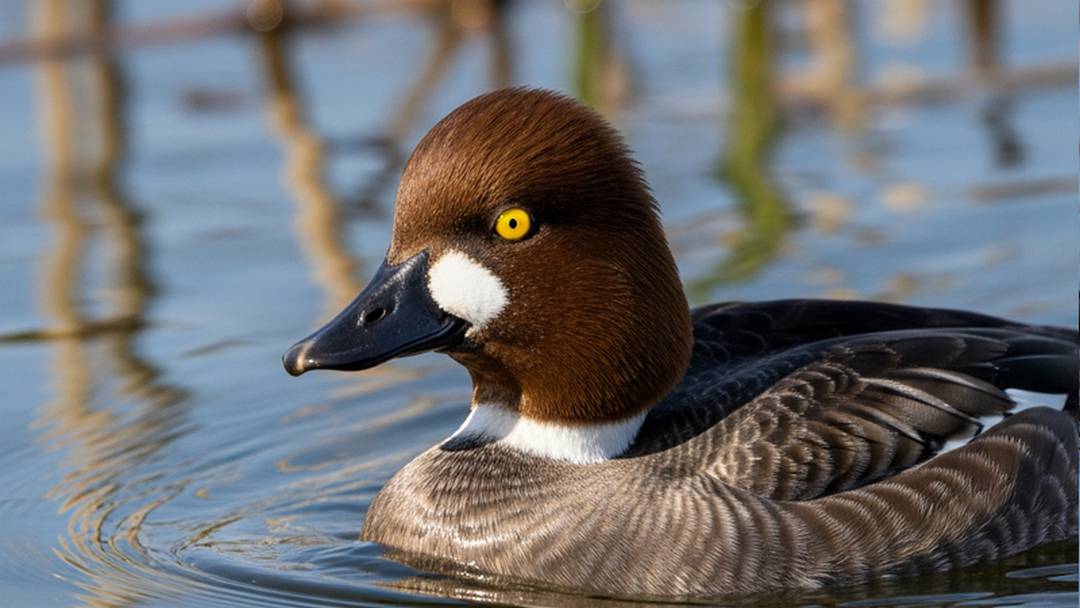
Female: Chocolate brown head, separated from the greyish body by a clean white collar (absent in juveniles). The bill is dark, often with a small yellow ring or tip in spring. The eye is pale yellow to white.
Juvenile: Resembles the female but duller, without a clean white collar, and with a darker eye.
In Flight: Flight is fast and direct. Both sexes show a large white square on the wing (speculum), very visible.
The female is more discreet but retains the characteristic head shape.
Dimensions (Common Goldeneye)
Characteristic
Data
Length
42 – 50 cm
Weight
500 – 1,200 g
Wingspan
65 – 80 cm
Lifespan
Up to 15 years
Not to be confused with...
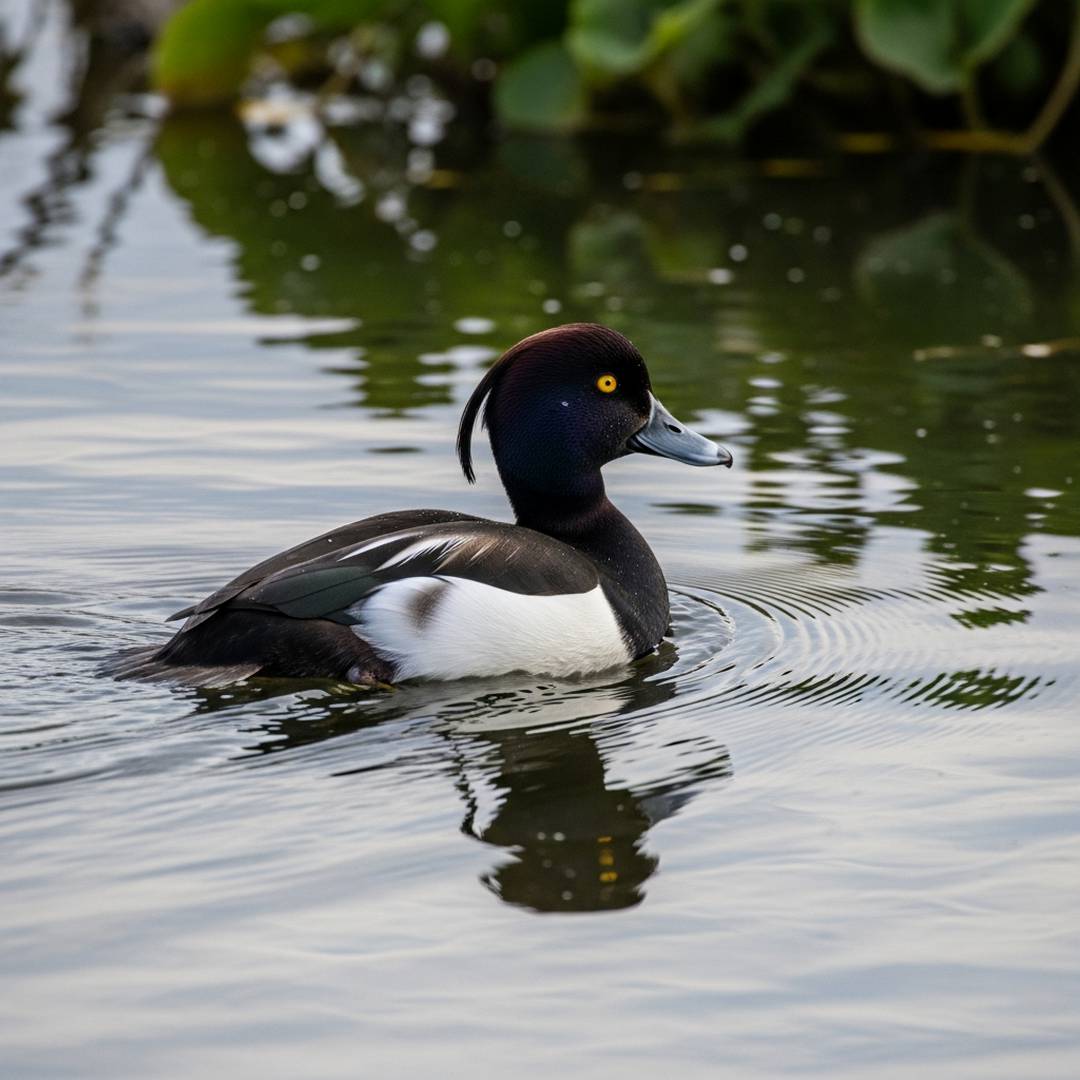
Tufted Duck
The male also has white flanks and a black back, but possesses a fine drooping crest at the back of the head, and its eye is yellow (not golden). It lacks the white patch on the cheek.
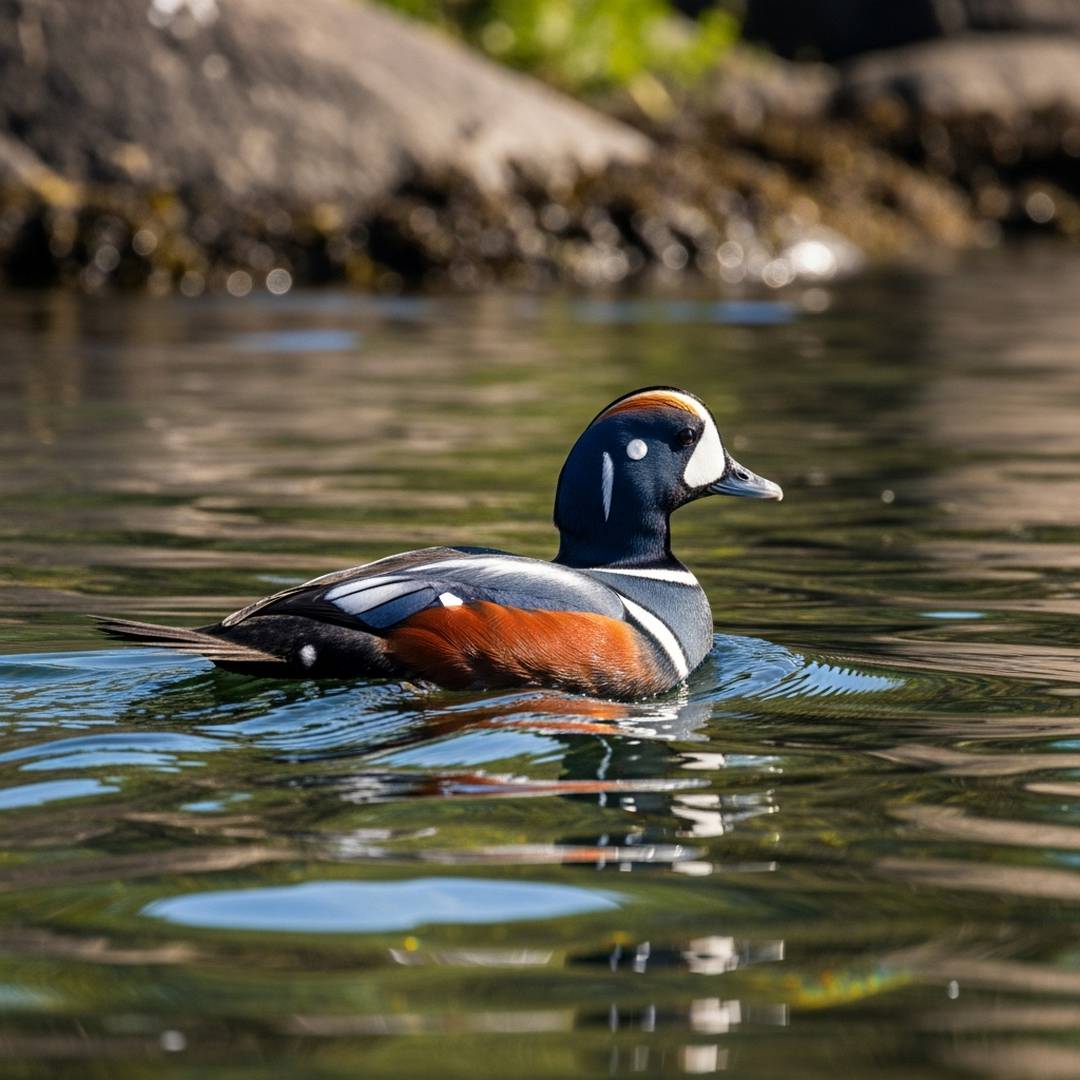
A rare species in Europe (mainly Iceland). The male is distinguished by a crescent-shaped white patch (not round) before the eye, and flanks showing more black. Its head has a more "square" or bulging forehead shape.
Song and Calls
The Common Goldeneye is generally silent in winter, but very vocal during courtship displays in spring. The sound of wings in flight is a constant auditory clue.
Wing Sound: A vibrant, metallic, and rapid whistling, audible even when the bird is flying high.
Courtship Display: The male performs a spectacular display by throwing his head back onto his back ("head-throw"), accompanied by a shrill, nasal call: "zree-zree" or "kee-r-r". The female responds with deeper "garr-garr" sounds.
0:00 / 0:00
Habitat and Distribution
The Common Goldeneye is a holarctic species, nesting in the boreal zones of Eurasia and North America.
Breeding: It is closely linked to the boreal forest (taiga). It seeks calm lakes, slow rivers, or ponds surrounded by old trees offering cavities for nesting.
Wintering: When fresh waters freeze in the north, it migrates south and towards the coasts. It is then found on large alpine lakes, reservoirs, rivers, estuaries, and sheltered marine bays. It tolerates salt water well in winter.
Distribution Map
Present all year (Resident)
Breeding range
Wintering range (Non-breeding)
Diet
It is an excellent diver that finds its food mainly underwater, often up to 4 or 5 meters deep. Its diet is predominantly animal:
Mollusks and crustaceans (mussels, small freshwater shrimp).
Aquatic insect larvae (caddisflies, dragonflies).
Occasionally small fish.
Some aquatic vegetation, especially in autumn.
To dislodge its prey, it may turn over stones at the bottom of the water with its bill.
Reproduction
The nesting habits of the Common Goldeneye are unique for a duck: it is a cavity nester.
The Nest: It settles in a tree hole, often an old Black Woodpecker nest or a natural decay cavity, sometimes located very high up (up to 10-15 meters). It readily adopts artificial nest boxes placed for its use.
Clutch: The female lays 8 to 11 greenish eggs between April and May. She incubates them alone for about 30 days.
The Departure: This is a spectacular moment. About 24 hours after hatching, the female calls the young from the ground. The ducklings climb to the entrance of the hole using their sharp claws and jump into the void, bouncing off the ground or leaves without injury due to their light weight, before being led to the water.
Conservation Status
The Common Goldeneye is classified as "Least Concern" (LC). Its populations are globally stable, or even increasing in some European regions thanks to the installation of nest boxes which compensates for the scarcity of old hollow trees.
However, it remains sensitive to intensive forestry (cutting of old dead trees) and acidification of boreal lakes which reduces food resources (invertebrates).
Frequently Asked Questions (FAQ)
Can the male and female be confused?
No, the dimorphism is very clear. The male has a black head and white body, while the female has a brown head and grey body. However, in eclipse plumage (late summer), the male resembles the female more closely, although he often retains traces of his breeding plumage on the wings.
What is the difference between the Goldeneye and the Tufted Duck?
The Common Goldeneye has a more triangular head and a white patch on the cheek (in the male). The Tufted Duck has a small crest at the back of the head and lacks the white patch on the face.