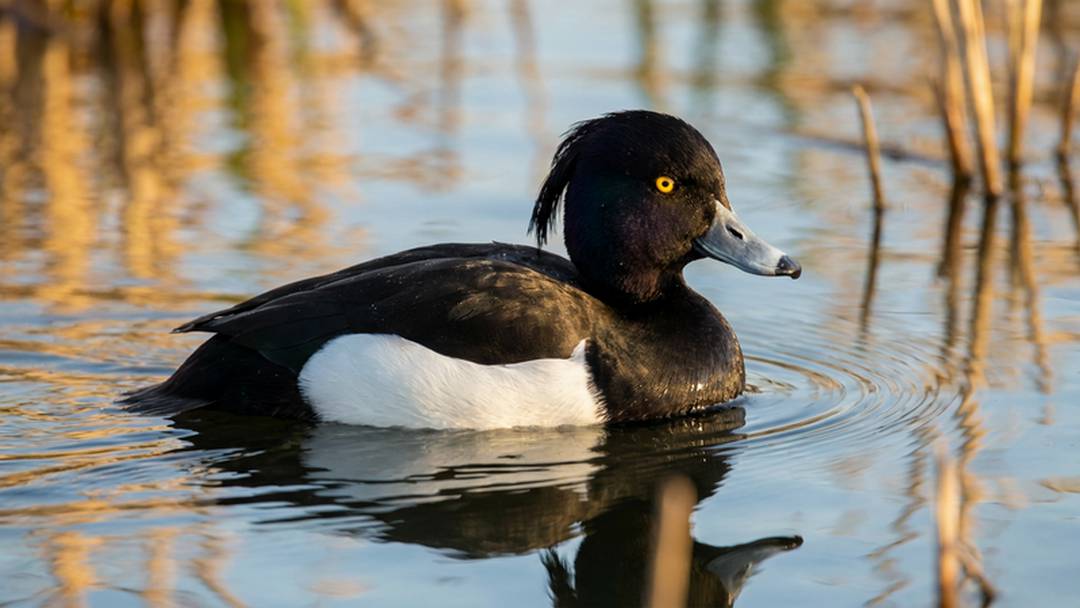
The male is unmistakable with its black plumage, white flanks, and drooping crest.
Introduction
The Tufted Duck (Aythya fuligula) is the most widespread diving duck in Europe. Often found on park lakes and gravel pits, it is easily recognizable by the crest that hangs from the back of its head. Its average dimensions are:
Length: 40 to 47 cm
Wingspan: 65 to 72 cm
Weight: 600 to 1,000 grams
Its scientific name fuligula comes from the Latin "fuligo" (soot) and "gula" (throat), referring to its dark coloration. It is a highly active diver, disappearing underwater with a small leap to find its food on the bottom.
Our Ornithologist's Advice
By the Les-Oiseaux.com team.
My personal advice: When observing ducks on a lake, look for the "corks".
Diving style: Tufted Ducks dive frequently and surface vigorously, bobbing up like a cork. They often dive in sync with others in the group.
The eye: If the light is poor and you cannot distinguish the colors well, focus on the eye. The bright yellow (golden) iris stands out clearly against the dark head of both the male and female.
Female ID: Be careful with females; they are quite variable. Some have a distinct white patch at the base of the bill, mimicking a Scaup, but the head shape and the hint of a crest usually give them away.
Have you spotted a Tufted Duck?
Share your experience and photos! Your sightings enrich the Les-Oiseaux.com community.
You can share as a guest or create an account to track your contributions.
Identification
The Tufted Duck shows clear sexual dimorphism, although both sexes share the yellow eye and the crest (tuft).
Adult Male (Breeding): Unmistakable contrast. The head, neck, breast, and back are black, often with slight purple reflections. The flanks are pure white. A long, thin, drooping crest hangs from the back of the head. The bill is blue-grey with a black tip.
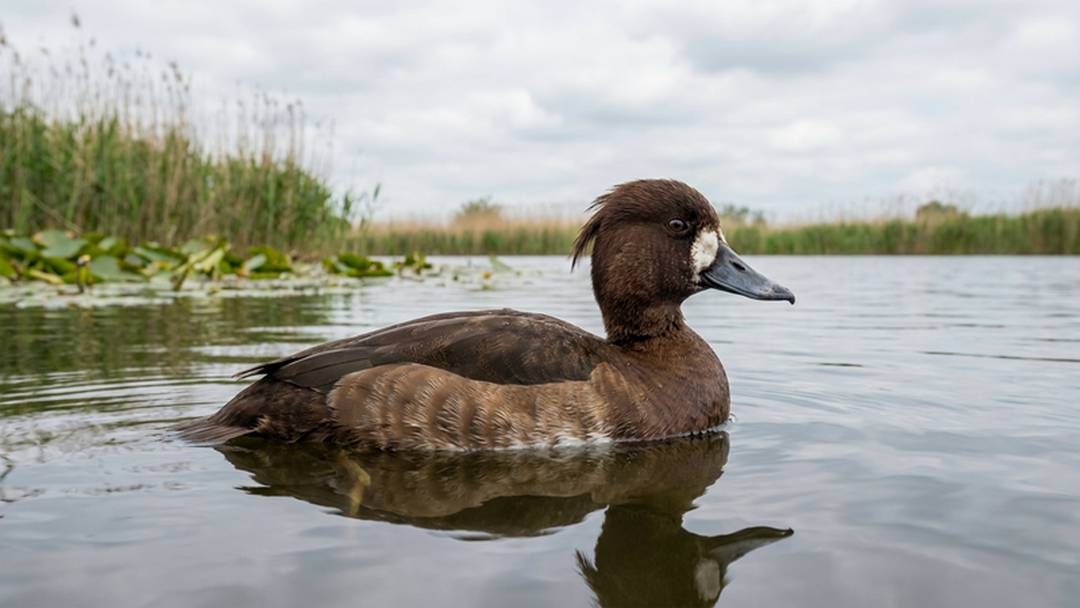
Female: Entirely dark brown, with lighter, brownish-grey flanks. Her crest is present but much shorter than the male's. She often has white undertail coverts and sometimes a small white patch at the base of the bill.
Juvenile: Resembles the female but is more uniform light brown, with a smaller crest and a duller eye.
In Flight: Flight is fast. Both sexes display a broad white wing bar (speculum) that runs almost the entire length of the wing.
The female is brown, but the yellow eye and head shape remain key features.
Dimensions (Tufted Duck)
Characteristic
Data
Length
40 – 47 cm
Weight
600 – 1,000 g
Wingspan
65 – 72 cm
Lifespan
Up to 12 years
Not to be confused with...
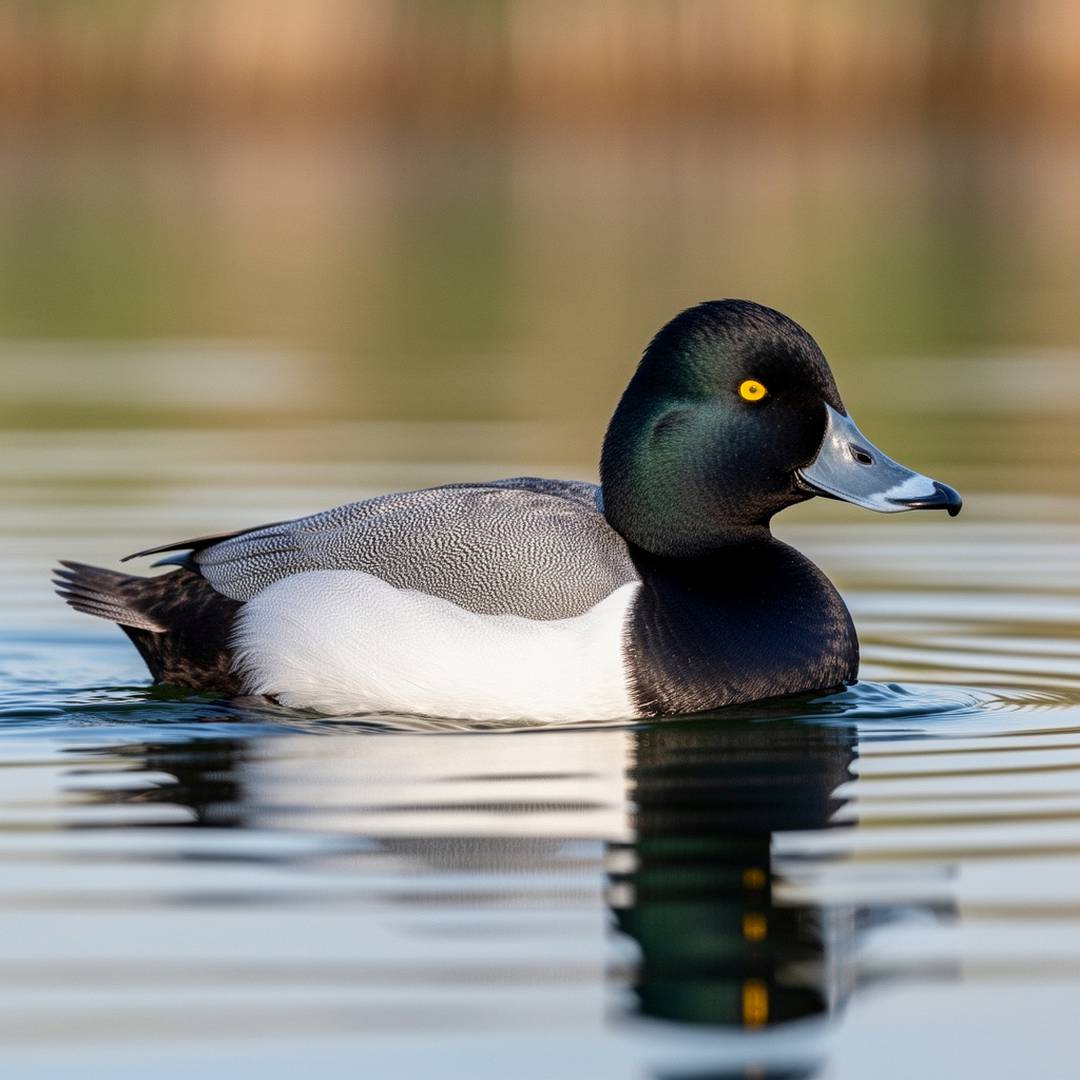
Greater Scaup
Similar to the Tufted Duck but lacks the crest. The male has a light grey back (finely vermiculated) rather than solid black. The female has a very distinct, large white patch at the base of the bill.
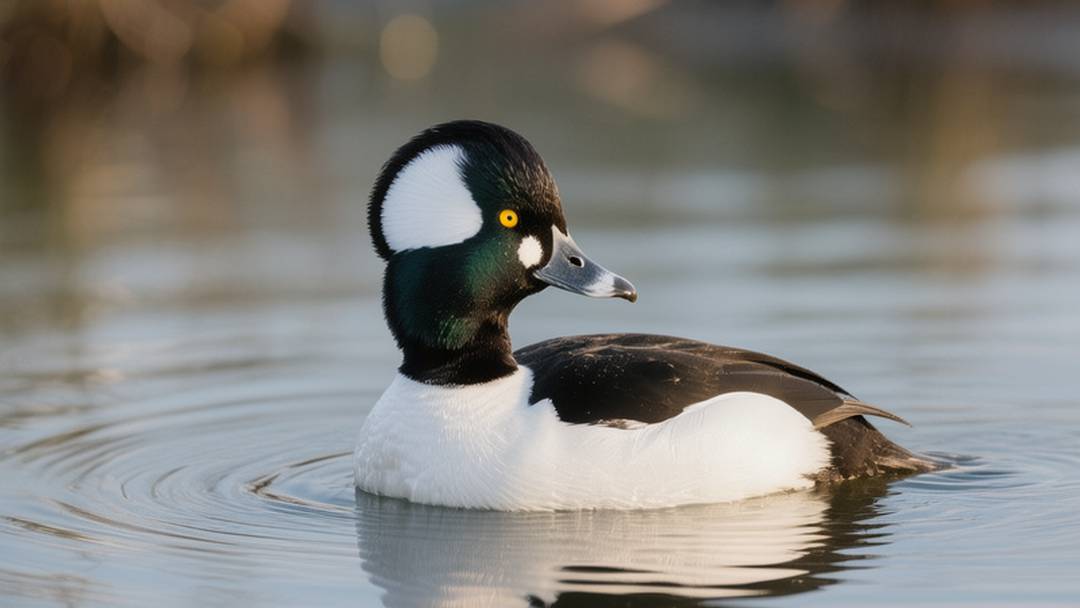
Common Goldeneye
The male Goldeneye has a white patch on the cheek (not the flank) and a triangular head shape without a hanging crest. Females have a chocolate brown head and white collar.
The Tufted Duck is generally a quiet bird, especially in winter. It becomes more vocal during the breeding season.
Male: Produces a soft, whistling bubbling sound during courtship, often difficult to hear from a distance ("weet-weet").
Female: More vocal, she emits a harsh, growling call: "karrr-karrr" or "kurr-kurr", often used in flight or when agitated.
0:00 / 0:00
Habitat and Distribution
The Tufted Duck is widespread across temperate and northern Eurasia.
Breeding: It favors lakes, marshes, and ponds with vegetated margins for nesting. It has adapted well to human-made environments like gravel pits and reservoirs.
Wintering: Large numbers migrate from Northern Europe and Russia to Western and Central Europe. In winter, they congregate on large, open bodies of fresh water, generally avoiding the open sea, though they can be found in estuaries.
Distribution Map
Present all year (Resident)
Breeding range
Wintering range (Non-breeding)
Passage
Diet
The Tufted Duck feeds primarily by diving, typically to depths of 3 to 7 meters. Its diet is mainly animal-based:
Mollusks: They are particularly fond of the invasive Zebra Mussel, which has allowed them to expand their range in many areas.
Aquatic insects and larvae (caddisflies, beetles).
Small crustaceans and occasionally small fish.
Seeds and aquatic plants (pondweed), especially in autumn and winter.
Reproduction
Unlike the Goldeneye which nests in trees, the Tufted Duck nests on the ground.
The Nest: Built by the female near the water's edge, often on islands to avoid predators. It is a hollow lined with grass and a thick layer of dark down, concealed in tall vegetation (reeds, tufts of grass).
Clutch: Laying occurs from May to June. The female lays 8 to 11 olive-grey or greenish eggs. She incubates alone for 23-28 days.
The Young: The ducklings are precocial and leave the nest shortly after hatching. They can dive almost immediately but feed mostly from the surface at first. They fledge after 45-50 days.
Conservation Status
The Tufted Duck is classified as "Least Concern" (LC). Its population has increased significantly in Western Europe during the 20th century, aided by the spread of the Zebra Mussel (a key food source) and the creation of artificial water bodies like reservoirs and gravel pits.
Frequently Asked Questions (FAQ)
Why does the female sometimes look like a Scaup?
Adult female Tufted Ducks can develop a patch of white feathers at the base of the bill, a trait characteristic of the Greater Scaup (Aythya marila). This can lead to confusion, but the Tufted Duck is smaller, has a darker back, and usually shows at least a short crest.
Do Tufted Ducks migrate?
Populations in mild climates (like the UK or Western France) are often resident. However, birds breeding in Scandinavia, Russia, and Eastern Europe are migratory, moving west or south to avoid freezing waters in winter.